

If a colleague collapsed in your workplace tomorrow morning, would you feel ready to step in, or would you be the one frozen in the crowd? According to the Health and Safety Executive (HSE) 2023/24 reports, there were 606,000 non-fatal injuries in UK workplaces, yet many people still feel a deep sense of anxiety about doing the wrong thing in an emergency. It’s perfectly natural to feel overwhelmed by the different course levels or worried about passing a formal assessment. If you’re looking for a clear path on how to become a designated first aider, you’re in the right place to turn that nervous energy into life-saving confidence.
We’ve designed this 2026 guide to be your reliable mentor. We’ve stripped away the jargon to provide a simple, step-by-step roadmap for your certification journey. You’ll learn how to choose between EFAW and FAW qualifications, meet your legal compliance requirements, and gain an Ofqual-regulated certificate through training that’s actually engaging. We’ll walk you through the entire process, from booking your first practical session to building the can-do attitude needed to handle any workplace incident with ease.
Key Takeaways
- Understand your legal responsibilities under the Health and Safety (First-Aid) Regulations 1981 and how to provide life-saving support with confidence.
- Learn exactly how to become a designated first aider by following a clear roadmap that begins with a professional workplace needs assessment.
- Discover the practical differences between EFAW and FAW qualifications to ensure you choose the right level of Ofqual-regulated training for your environment.
- Master the process of maintaining your certification through timely renewals and annual refreshers to ensure your skills remain sharp and compliant.
- Gain the peace of mind that comes from expert-led training designed to transform complex regulations into manageable, life-saving actions.
What is a Designated First Aider? Understanding the Role and Responsibility
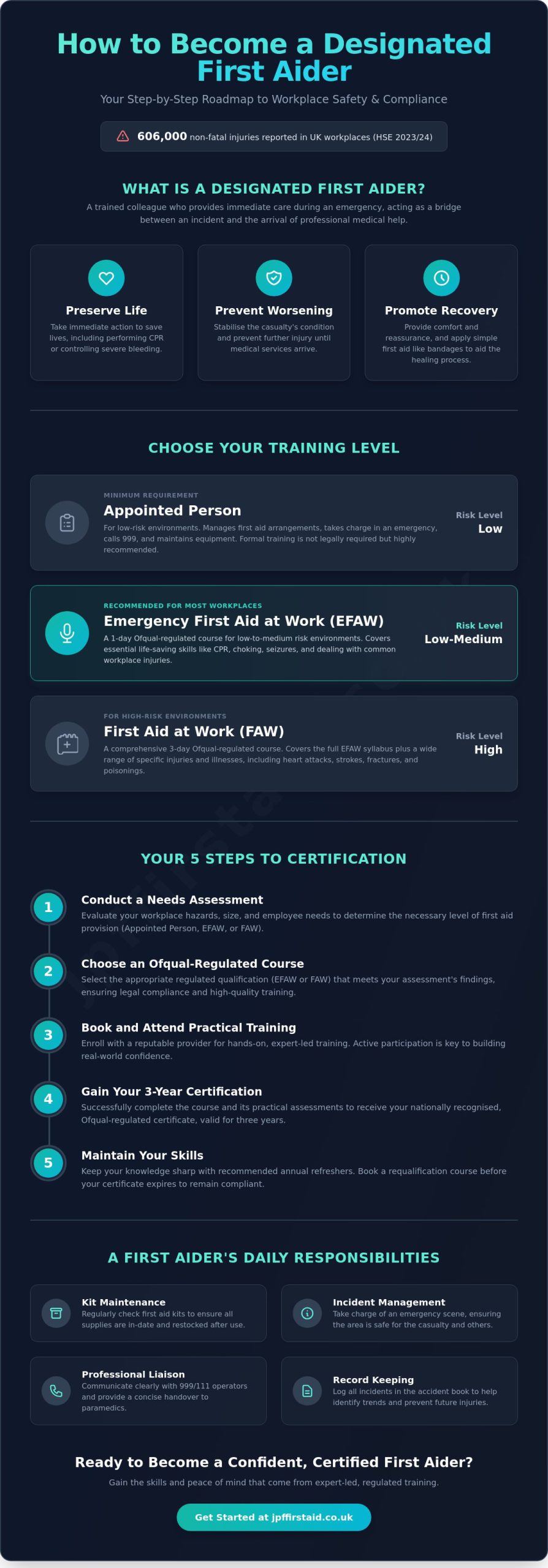
If you are exploring how to become a designated first aider, you’re looking at a role that sits at the very heart of workplace safety. Under the Health and Safety (First-Aid) Regulations 1981, every UK employer has a legal obligation to ensure their staff receive immediate attention if they are injured or taken ill at work. A designated first aider is the person trained to provide this help. It is a position of trust that requires a calm head and a practical approach to problem-solving.
Your primary mission is to act as a bridge between the moment an accident happens and the arrival of professional medical help. Understanding What is first aid involves mastering the three “Ps”: preserving life, preventing the condition from worsening, and promoting recovery. While you aren’t a doctor or a paramedic, your swift actions in those first few minutes can significantly improve a person’s outcome. It’s a rewarding responsibility that builds immense confidence and makes your workplace a much safer environment for everyone.
The Legal Framework: HSE Requirements
The Health and Safety Executive (HSE) requires employers to provide “adequate and appropriate” first aid equipment, facilities, and personnel. This isn’t a vague suggestion; it’s a mandatory requirement based on a thorough risk assessment of the specific workplace. A high-risk environment, such as a manufacturing plant with heavy machinery, will require more intensive training than a small retail shop.
There is a clear distinction between a fully qualified First Aider and an Appointed Person. An Appointed Person is the minimum legal requirement for low-risk sites and is responsible for taking charge of first aid arrangements, such as calling the emergency services. While an Appointed Person doesn’t necessarily need formal first aid training to meet the bare legal minimum, most businesses choose to provide it to ensure better protection. To truly understand how to become a designated first aider, you’ll need to complete a regulated qualification like the First Aid at Work (FAW) or Emergency First Aid at Work (EFAW) certificate.
What Does a First Aider Actually Do?
The role is about much more than just applying bandages during an emergency. It involves a proactive commitment to health and safety that happens every day. You’ll be the go-to person for several critical tasks:
- Kit Maintenance: You’ll regularly check the first aid box to ensure supplies are in-date and restocked after use.
- Incident Management: When someone falls ill or is injured, you take charge of the scene, ensuring it’s safe for the casualty and others.
- Professional Liaison: You’ll communicate clearly with the 999 or 111 operators and provide a concise handover to paramedics when they arrive.
- Record Keeping: You must ensure every incident is recorded in the accident book, which helps the business identify trends and prevent future injuries.
In 2023, the HSE reported that 561,000 workers sustained a non-fatal injury at work. Being the person who knows exactly what to do in these situations doesn’t just fulfill a legal tick-box; it fosters a culture of care. Your presence ensures that help is never more than a few moments away, providing peace of mind to your colleagues and your employer alike.
The HSE Framework: Which Level of Training Do You Need?
To understand how to become a designated first aider, you must first evaluate your specific workplace environment. The Health and Safety Executive (HSE) doesn’t offer a one-size-fits-all rule; a quiet office carries different risks than a busy construction site. Instead, you’ll need to conduct a first-aid needs assessment. This simple process identifies hazards and ensures you have enough cover for your team’s specific needs.
The UK workplace framework typically operates across four layers of provision. This starts with an Appointed Person, who manages equipment, and moves up to the 1-day Emergency First Aid at Work (EFAW) and the 3-day First Aid at Work (FAW) qualifications. For specialized industries, a fourth layer involves bespoke training for specific clinical risks. Choosing these ‘off-the-peg’ regulated levels is the safest route for compliance. It ensures your business follows the official HSE guidance without the guesswork.
Matching Training to Workplace Risk
Risk levels directly dictate your training path. In low-risk environments like shops or standard offices, the general rule is to have at least one first aider for every 100 employees. However, if you work in high-risk sectors such as manufacturing or warehousing, that ratio changes to one first aider for every 50 people. You must also consider ‘special hazards’ that standard courses might not cover. If your staff works at heights or handles dangerous substances like hydrofluoric acid, you’ll need additional, specific modules to stay safe and compliant.
The Importance of Ofqual Regulated Qualifications
When you’re researching how to become a designated first aider, you’ll find many providers offering quick certificates. It’s vital to choose an Ofqual regulated qualification. ‘Regulated’ means the training is monitored by an external awarding body, ensuring the content is accurate and the assessment is rigorous. This provides a ‘due diligence’ shield for employers, proving they’ve met their legal obligations with high-quality instruction. You can verify a provider’s credentials by checking their training centre number against the Register of Regulated Qualifications. For more detail on specific compliance for smaller teams, see our Emergency First Aid at Work guide.
If you’re feeling overwhelmed by the regulations, don’t worry. We can help you identify the right path with hassle-free training solutions that bring expert knowledge directly to your workplace.
EFAW vs. FAW: Choosing the Right Qualification for Your Role
Deciding which path to take is the first practical step in learning how to become a designated first aider. Your choice usually boils down to two regulated qualifications: the 1-day Emergency First Aid at Work (EFAW) or the more comprehensive 3-day First Aid at Work (FAW) course. To make an informed decision for your business, you should consult HSE’s official guidance on First-Aid Regulations. This document helps you perform a risk assessment to determine exactly what level of cover your team needs to stay safe and compliant.
Emergency First Aid at Work (Level 3)
The EFAW course is a fast-paced, 1-day session that focuses on life-saving basics. It’s the standard entry-level qualification for most UK office workers and those in lower-risk environments like retail or libraries. During the 6 hours of training, you’ll master CPR, learn to use an Automated External Defibrillator (AED), and practice managing choking and heavy external bleeding. It’s a practical, engaging way to gain the skills needed to stabilize a casualty while waiting for an ambulance. If your workplace has a small headcount and few physical hazards, this qualification provides a solid foundation of confidence.
First Aid at Work (Level 3)
The 3-day FAW course is the “gold standard” for workplace safety. This 18-hour curriculum is necessary for high-risk environments like construction sites, warehouses, or factories where the potential for serious injury is higher. It covers everything in the EFAW syllabus but adds extensive training on managing fractures, burns, eye injuries, and poisoning. You’ll also learn to recognize and treat major medical conditions such as heart attacks, strokes, and anaphylaxis. This course provides the deepest level of confidence and skill, ensuring you’re prepared for almost any scenario. It’s also a legal requirement for larger workforces, typically those with 50 or more employees.
We understand that taking three days out of a busy schedule can be difficult. That’s why we offer a “blended learning” option for the FAW qualification. This modern approach lets you complete one day of theory online through an interactive portal, followed by two days of hands-on, practical training at your site or our venue. It’s a flexible, hassle-free solution that ensures you still get the vital face-to-face practice required for certification. Choosing the right course isn’t just about ticking a box; it’s about ensuring you have the specific skills to save a life in your unique work environment. When you’re ready to learn how to become a designated first aider, we’ll help you pick the qualification that fits your needs perfectly.
5 Steps to Becoming a Designated First Aider in 2026
Learning how to become a designated first aider is a straightforward process that builds vital skills for your workplace. It’s a structured journey that ensures you have the competence to save lives while keeping your business compliant with the Health and Safety (First-Aid) Regulations 1981. Follow these five steps to complete your journey.
- Step 1: Conduct a Needs Assessment. Review your workplace hazards and staff numbers. A small retail shop has different requirements than a high-risk manufacturing plant. This assessment determines how many first aiders you need.
- Step 2: Select the Right Course. Most UK workplaces require either the 1-day Emergency First Aid at Work (EFAW) or the more comprehensive 3-day First Aid at Work (FAW) qualification.
- Step 3: Pick a Regulated Provider. Choose a trainer that offers Ofqual-regulated certifications. This ensures your qualification is recognized by the HSE and meets high national standards.
- Step 4: Complete the Training. Attend the sessions and participate in practical scenarios. This is where you’ll learn how to become a designated first aider by practicing CPR, using a defibrillator, and managing wounds.
- Step 5: Get Certified. Once you pass the continuous assessment, you’ll receive a certificate valid for three years. Your employer then officially records your role in the company’s health and safety policy.
What to Expect on Your Training Day
Forget sitting in a room watching endless slide decks for hours. Modern training focuses on “doing” rather than just “listening.” You’ll move quickly from theory into hands-on practice. Your trainer acts as a mentor, guiding you through life-saving techniques until they feel like second nature. JPF First Aid makes these sessions engaging and fun because we know that people remember more when they’re relaxed. This approach builds the genuine confidence you’ll need if a real emergency happens at work.
Demystifying the Assessment Process
Many learners feel anxious about a final exam, but the process is much more supportive than you might think. Assessment is continuous throughout the course. Your trainer observes your practical skills, such as performing CPR or applying a bandage, as you practice. While there are some multiple-choice questions to check your theory knowledge, the focus remains on your physical ability to help. If you don’t pass a specific element the first time, your mentor provides support and coaching to help you get it right. The goal is to ensure every student leaves feeling capable and ready to help.
Ready to take the first step? Book your Ofqual-regulated first aid course today and gain the confidence to save lives.
Maintaining Your Status: Renewals and Modern Designations
Once you’ve learned how to become a designated first aider, your journey doesn’t end with the initial certificate. First aid is a perishable skill. Your regulated qualification, whether it’s First Aid at Work (FAW) or Emergency First Aid at Work (EFAW), is valid for exactly three years. After this 36-month period, your legal status as a designated responder expires, and you’ll no longer be counted toward your employer’s health and safety compliance requirements.
While the certificate lasts three years, the Health and Safety Executive (HSE) strongly recommends attending a half-day annual refresher course. Research from the Resuscitation Council UK suggests that CPR skills and knowledge can begin to fade as early as six months after training. Regular practice sessions ensure you keep that “can-do” attitude and the confidence to step in during a real emergency. Staying updated isn’t just about paperwork; it’s about being genuinely ready to save a life.
The Re-qualification Cycle
If you already hold a valid FAW certificate, you don’t need to sit the full 3-day initial course again. You can opt for the 2-day FAW Re-qualification course instead. This streamlined version focuses on refreshing your practical skills and updating you on any changes to UK resuscitation guidelines. It’s a time-efficient way to maintain your status while keeping your workplace safe.
You must complete this training before your current certificate expires. If you let your qualification lapse by even a single day, you’ll typically have to start from scratch with the full 3-day course. To stay ahead of the deadline, you can view our full list of First Aid Courses in 2026 to find a renewal date that fits your schedule.
Mental Health First Aid: A New Designation
Modern workplaces recognize that safety isn’t just about physical injury. According to Mind, 1 in 4 people in England experience a mental health problem each year. This statistic has led many businesses to expand their safety teams by designating Mental Health First Aiders. This role acts as a vital complement to traditional first aid, creating a holistic approach to staff wellbeing.
When you’re looking at how to become a designated first aider for the modern era, adding mental health support to your skillset is a powerful move. It transforms you into a versatile mentor who can handle both a cardiac arrest and a panic attack with equal composure. For more details on this specific responsibility, refer to our Mental Health First Aid guide. By combining these designations, you help build a workplace culture where everyone feels truly looked after.
Take the Lead with Life-Saving Skills in 2026
Securing your workplace starts with identifying the right HSE framework for your specific environment. Whether you need the one-day Emergency First Aid at Work (EFAW) or the comprehensive three-day First Aid at Work (FAW) qualification, meeting these legal requirements ensures your team stays safe and compliant. Understanding how to become a designated first aider is the first step toward creating a culture of preparedness that protects everyone on-site. It’s about more than just a certificate; it’s about having the skills to act when every second counts.
You don’t have to navigate these regulations alone. JPF First Aid provides multi-award-winning training that replaces dry, clinical lectures with engaging and fun practical sessions. We bring the expertise directly to your doorstep with nationwide on-site training for groups of up to 12 people. This bespoke approach ensures your team learns in their own environment, building the genuine confidence needed to handle real-world emergencies. We focus on making the process hassle-free so you can focus on your business.
Ready to empower your workplace? Book your Ofqual-regulated first aid training with JPF First Aid today. You’ve got the potential to save a life, and we’re here to help you make it happen.
Frequently Asked Questions
Can I be forced to be a first aider at work?
You cannot be forced to become a first aider unless your employment contract specifically requires it as part of your job description. Most employers look for volunteers because the role requires a genuine willingness to help in emergencies. If you’re uncomfortable with the responsibility, it’s best to speak with your manager. Having a willing, confident person is much more effective for workplace safety than someone who has been pressured into the role.
How much extra pay do first aiders get?
There’s no legal requirement for employers to pay you extra for being a first aider. However, many UK companies offer a small annual allowance or “honorarium” to recognize the extra responsibility. According to industry surveys, this typically ranges from £100 to £350 per year depending on the company size. You should check your internal company policy or staff handbook to see if your business provides this type of financial incentive for the role.
Is a first aider legally liable if something goes wrong?
It’s extremely unlikely that you’ll be held legally liable if something goes wrong while you’re providing first aid in good faith. The Social Action, Responsibility and Heroism Act 2015 protects individuals who act to help others in an emergency. As long as you stay within the scope of your training and don’t act with gross negligence, the courts take a very sympathetic view of those trying to save lives.
What is the difference between a first aider and an appointed person?
A designated first aider holds a regulated qualification like First Aid at Work (FAW), while an appointed person simply manages first aid arrangements. If you want to know how to become a designated first aider, you must complete a practical course that lasts between one and three days. An appointed person’s role is limited to looking after the first aid kit and calling emergency services. They don’t have the formal training required to provide actual medical treatment to an injured colleague.
How long does a first aid certificate last in the UK?
Your first aid certificate is valid for exactly three years from the date of issue. After this period, you must complete a requalification course to maintain your status. The Health and Safety Executive (HSE) also strongly recommends attending a half day annual refresher session. This keeps your skills sharp and ensures you remain confident in your ability to handle a real life emergency during that three year cycle.
Can I take a first aid course online to become a designated first aider?
You cannot become a fully qualified designated first aider through a purely online course. While “blended learning” allows you to do some theory online, the HSE requires practical, face to face assessment for life saving skills like CPR. We ensure our training is hands on and engaging because you can’t learn to save a life just by clicking a mouse. You need to practice on manikins to gain real confidence in your abilities.
How many first aiders does my small business need?
Your specific needs depend on your workplace risk assessment, but even small, low risk offices with fewer than 50 employees should have at least one appointed person. For higher risk environments like construction or manufacturing, the requirements are much stricter. Most small businesses find that having two trained first aiders provides the best cover for holidays and sick leave. This ensures you’re never left without a qualified person on site during working hours.
What happens if my first aid certificate expires?
If your certificate expires, you’re no longer considered a qualified first aider and cannot legally perform the role at work. You must stop acting as the designated person until you complete a new training course. Most providers offer a 28 day grace period for requalification, but it’s much safer to book your refresher before the expiry date. This keeps your business compliant and ensures your life saving skills stay current and effective.
Recent Comments