

A digital certificate might satisfy your insurance provider, but it won’t give you the muscle memory to save a life when every second counts. When weighing up online vs in-person first aid training, you likely feel the pressure to balance a busy schedule with the legal necessity of workplace safety. It’s frustrating to spend money on a course only to worry that your team might still freeze during a real emergency. We understand that you need a solution that is both hassle-free and genuinely effective.
This guide explores the critical differences between digital and classroom learning to help you make the right choice in 2026. You will learn how to meet Ofqual regulations and HSE compliance while ensuring your team gains the “can-do” attitude needed for a crisis. We’ll break down the practical differences in skill retention and value for money, so you can feel confident that your investment translates into real-world competence. We’ll also examine why the Resuscitation Council UK continues to emphasise hands-on practice as the gold standard for life-saving success.
Key Takeaways
- Understand the critical pros and cons of online vs in-person first aid training to ensure your choice meets UK legal requirements and provides genuine life-saving skills.
- Discover why muscle memory and hands-on practice are essential for overcoming the “panic reflex” during a real-world emergency.
- Learn how to navigate HSE and Ofsted regulations to ensure your certification is “suitable and sufficient” for your specific workplace or sector.
- Use our step-by-step guide to assess your environment’s risk level and select the most effective training format for your team’s needs.
- Find out how a relaxed, engaging, and fun learning environment builds the lasting confidence needed to act decisively when it matters most.
The Evolution of First Aid Training: Online vs In-Person
The way people learn life-saving skills changed significantly between 2020 and 2026. You now have three primary choices: purely online modules, traditional classroom sessions, or a blended approach that combines both. This debate over online vs in-person first aid training has intensified because digital platforms now offer high-definition video and interactive simulations. However, your decision isn’t just about convenience. It’s about meeting legal standards. Understanding the history and principles of first aid shows that while theory is vital, the ability to act under pressure is what saves lives.
You need to distinguish between “awareness” training, which provides a basic overview for personal knowledge, and “regulated qualification” courses that satisfy the Health and Safety Executive (HSE) requirements. Your specific role, whether you’re a designated office first aider or a construction site manager, determines which path you must take. Choosing the wrong version could leave your business non-compliant and your staff unprepared. Blended learning has emerged as a popular middle ground, allowing you to complete theory online before attending a shorter practical session to prove your skills.
What is Online First Aid Training?
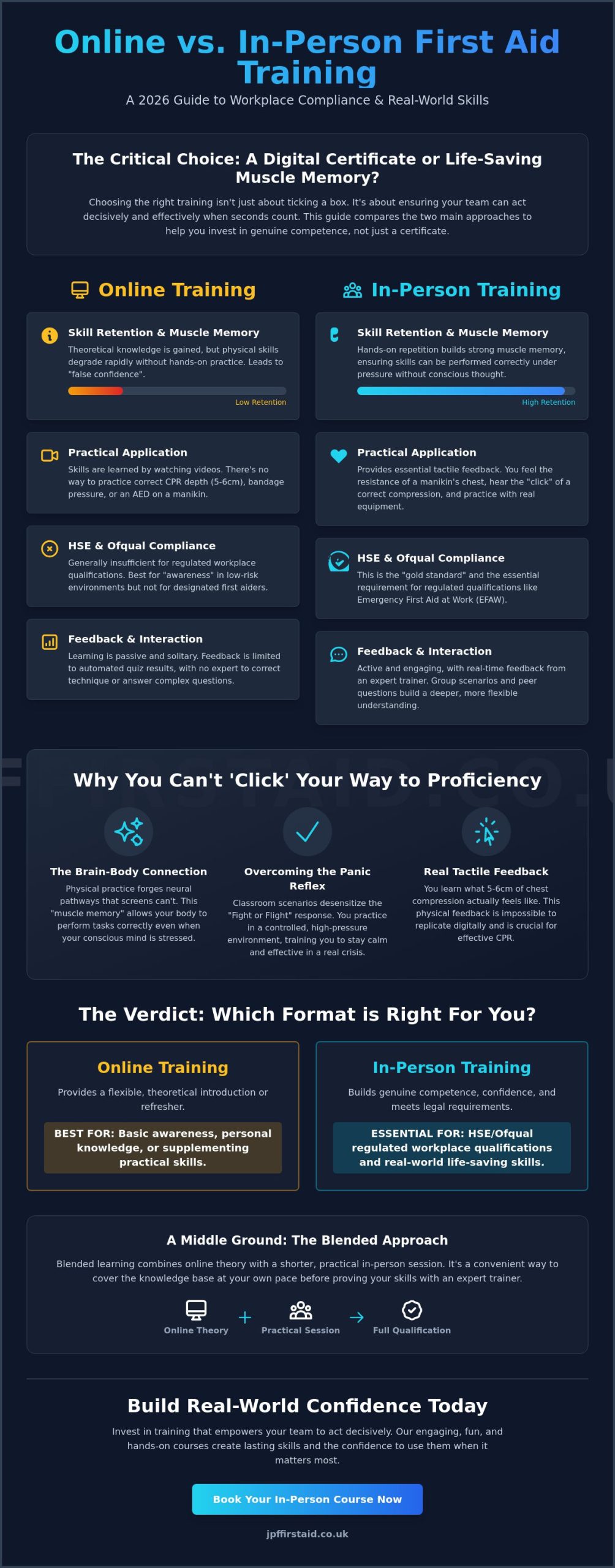
Online training delivers theoretical knowledge through videos, slides, and interactive quizzes. It’s a fantastic tool for low-risk environments where you just need a refresher or a basic introduction to safety. When comparing online vs in-person first aid training, the online route is often seen as the more flexible option. However, the lack of physical assessment means these courses usually don’t carry Ofqual regulation. They’re great for building confidence but won’t satisfy the legal requirements for most UK workplaces.
What is In-Person First Aid Training?
This is the gold standard for formal qualifications. You’ll work with an expert trainer who provides real-time feedback on your technique. This hands-on practice is essential for building the muscle memory required during a crisis. JPF sessions are designed to be engaging and fun, using scenario-based learning to mimic real-life emergencies. This remains the essential requirement for a regulated Emergency First Aid at Work certificate, giving you the confidence to act when it matters most.
The Science of Skill Retention: Why Hands-On Practice Matters
When you’re deciding between online vs in-person first aid training, the most critical factor isn’t convenience; it’s how your brain stores life-saving information. A study on first aid skill retention highlights that while online learners often grasp theory well, their ability to perform physical tasks drops significantly compared to those who’ve had hands-on practice. You simply cannot “click” your way to CPR proficiency. It requires feeling the 5-6cm depth of a chest compression and the specific resistance of a manikin’s chest plate.
Physical training creates a tactile feedback loop that digital screens can’t replicate. In a classroom, you hear the “click” of a correctly compressed manikin and feel the genuine fatigue in your arms after two minutes of cycles. Group interaction adds another vital layer to this process. When a peer asks a question you hadn’t considered, or you watch a classmate correct their hand placement, your brain builds a more robust and flexible map of the skill. This shared environment turns a dry list of instructions into a lived experience.
The Brain-Body Connection in a Crisis
Your brain retrieves information differently when your heart is racing at 120 beats per minute. Learning in a relaxed home environment doesn’t prepare you for the “Fight or Flight” response triggered by a real emergency. Physical training desensitises the panic reflex by putting you in a controlled version of a high-pressure situation. We don’t just want you to practice until you get it right; we want you to practice until you cannot get it wrong. Muscle memory is the process by which your motor system learns a task so thoroughly through repetition that it can be performed without conscious effort during a crisis.
The Limitations of Digital-Only Learning
Watching a video of someone applying a pressure bandage is a passive activity. Managing a catastrophic bleed yourself is an active, physical challenge. Digital-only learning often creates “false confidence,” where you believe you’re prepared because you passed a multiple-choice quiz, but your hands freeze when faced with a real injury. Understanding what are the first aid essentials is only the first step. The second, more important step is the physical intervention required to save a life. If you want to build genuine confidence, our bespoke first aid courses focus on the practical, hands-on experience you need to feel truly ready to help.
By choosing a format that prioritises physical practice, you ensure that when a crisis happens, you aren’t just remembering a video; you’re repeating a movement your body already knows. This distinction is often what makes the difference in a successful emergency outcome.
Comparing the Pros, Cons, and Legal Compliance
Choosing between online vs in-person first aid training isn’t just a matter of convenience. It’s a decision that impacts your legal standing and the safety of your workforce. While digital platforms offer flexibility, they often struggle to replicate the high-pressure environment of a real-life medical emergency. You need to weigh the immediate ease of a login against the long-term confidence of hands-on practice.
Is Online First Aid Training HSE Compliant?
The Health and Safety Executive (HSE) is clear about what constitutes “suitable and sufficient” training. For most workplace roles, particularly those requiring Emergency First Aid at Work (EFAW) or First Aid at Work (FAW) certificates, a practical assessment is mandatory. You cannot prove you can perform effective chest compressions or manage a catastrophic bleed solely by clicking a mouse. A trainer must physically observe your technique to ensure you’re competent.
Online-only certificates are generally only acceptable for annual refreshers or theory-based topics like basic health and safety awareness. If you rely on a 100% digital course for your primary workplace cover, you’re taking a massive risk. In the event of an accident, your insurance provider may refuse to pay out if they discover your first aider hasn’t been assessed in person. This leaves business owners personally liable for legal costs and potential fines that far outweigh any initial savings.
The True Cost of Training
It’s tempting to look at a £25 online module and see a bargain. However, the sticker price is only one part of the equation. You must consider the indirect costs of ineffective training. If a staff member completes a low-quality course and lacks the confidence to step in during a crisis, the “hidden cost” becomes the safety of your team. According to HSE data for 2022/23, workplace injuries and ill health cost UK employers an estimated £3.5 billion. Proper training reduces these incidents by fostering a proactive safety culture.
Viewing a first aid course as an investment rather than a generic business expense changes your perspective on ROI. In-person training provides:
- Direct Feedback: Expert instructors correct your form instantly, preventing bad habits.
- Peer Learning: Discussing scenarios with colleagues builds team cohesion and confidence.
- Equipment Familiarity: You get hands-on time with AEDs and manikins, so the first time you use them isn’t in a real emergency.
- Accountability: Unlike an online video that can play in the background, a classroom setting ensures 100% engagement.
While online vs in-person first aid training both have their place in 2026, the gold standard remains the face-to-face experience. It’s the only way to ensure your team is truly ready to save a life when every second counts.
Decision Guide: Selecting the Best Format for Your Needs
Choosing the right path between online vs in-person first aid training depends on your specific goals and environment. It’s not a one-size-fits-all situation; your decision should be guided by safety, compliance, and how you learn best. To help you decide, we’ve broken the process down into four logical steps.
- Step 1: Identify your legal obligations. If you’re a business owner, the Health and Safety (First Aid) Regulations 1981 dictate your requirements. Schools and nurseries must follow Ofsted or EYFS guidelines. Personal interest learners have the most flexibility, but professionals must ensure their certificate is regulated.
- Step 2: Assess the risk level of your environment. A low-risk office with 10 employees has very different needs than a high-risk construction site. If your workplace involves heavy machinery or dangerous heights, the hands-on practice of an in-person course is vital.
- Step 3: Consider the learning styles of your delegates. Some people thrive with digital modules they can pause and rewind. Others need to physically feel the resistance of a manikin’s chest during CPR to feel confident.
- Step 4: Evaluate the “Blended” option. This modern compromise combines the best of both worlds, offering a balance that suits most modern UK businesses.
When to Choose Blended Learning
Blended learning is a smart solution that splits the curriculum into two parts. You complete the theoretical knowledge through an interactive online portal first. Once that’s done, you attend a shortened practical session to demonstrate your skills. It’s an efficient way to learn that reduces “time out of the business” by 50% compared to traditional three-day courses. This format is the perfect fit for a paediatric first aid course Cannock, as it allows busy early years practitioners to study the theory at home and focus their classroom time on life-saving physical techniques.
Choosing for Specific Roles
The best format often depends on what you do for a living or your role in the community. For parents, accessible online or short community-based sessions work well because they focus on common childhood injuries like choking or burns without the pressure of a professional exam.
If you’re a Designated First Aider in a high-risk workplace, we always recommend full in-person training. You need maximum competence and the chance to ask our expert instructors specific questions about your site. However, for subjects like Mental Health First Aid, distance learning works exceptionally well. Since these courses are largely theoretical and discursive, a virtual classroom allows for deep, meaningful conversation from the comfort of your own space.
Ready to empower your team with life-saving skills? Whether you need a local classroom or a flexible digital solution, we can help you find the perfect first aid course for your needs.
Beyond the Certificate: Building Real-World Confidence
When you weigh up the pros and cons of online vs in-person first aid training, the deciding factor shouldn’t just be the price or the time spent in a chair. It’s about how you feel when a real emergency happens. At JPF First Aid, we believe that a certificate is just the start of the journey. Our philosophy centers on creating a “can-do” attitude through sessions that are genuinely engaging and fun. We move away from the dry, clinical approach that often makes people switch off. Instead, we create a relaxed atmosphere where questions are encouraged. Data from educational psychology suggests that when delegates are comfortable and enjoying themselves, they retain information significantly better than in high-stress or boring environments.
An experienced mentor brings value that a computer screen simply cannot replicate. Our trainers share real-world insights, answering those tricky “what if” questions based on years of practical experience. This human connection bridges the gap between theory and the high-pressure reality of a workplace accident. You aren’t just watching a video; you’re learning from a professional who has been there and done it.
The JPF Approach to Interactive Learning
We don’t just read from a textbook or click through slides. Our training involves hands-on use of modern equipment and realistic scenarios tailored to your specific environment. Whether you work in a high-risk warehouse or a local primary school, we adapt the content to your specific hazards. The goal is simple: every person should leave the room thinking “I can do this” rather than just “I passed the test.” By focusing on practical application and bespoke scenarios, we ensure your team has the muscle memory needed to act fast when seconds count.
Taking the Next Step
Transitioning from considering your options to having a fully qualified, confident team is straightforward. We specialise in making the process hassle-free by bringing the training directly to your premises. This on-site approach saves you the logistical headache of sending staff to a remote centre and ensures they learn in the environment where they actually work. We can train groups of up to 12 delegates per session, ensuring everyone gets individual attention from our expert mentors.
Choosing between online vs in-person first aid training ultimately comes down to the level of confidence you want your team to possess. If you want more than a tick-box exercise, trust the experts to build real-world skills. Contact JPF First Aid today to book your on-site session and give your staff the peace of mind they deserve. First Aid Training You Can Trust starts with a conversation.
Take the Next Step Toward Life-Saving Confidence
Deciding on the best approach for online vs in-person first aid training requires a balance between convenience and practical competence. While digital platforms offer theory, the Resuscitation Council UK consistently highlights that physical chest compressions and manikin practice are essential for muscle memory. You’ll find that 100% of our Ofqual regulated qualifications meet the strict Health and Safety Executive (HSE) standards required for workplace compliance across the United Kingdom. We focus on transforming dry, technical requirements into an experience that’s genuinely engaging and fun. It’s about more than just a piece of paper; it’s about the 30 seconds that could save a colleague’s life.
As a multi-award-winning training provider, JPF First Aid brings expert-led sessions directly to your doorstep. We’ve built our reputation on being a reliable expert mentor for businesses and individuals alike. Our approach ensures you don’t just learn the theory but leave with the genuine confidence to act when it matters most. You’ll benefit from expert instructors who prioritize your success and make the learning process feel relaxed and professional. Get your team certified with a provider that values practicality and community safety above all else.
Book Your Engaging and Professional First Aid Training Today
You’re in safe hands with us, and we can’t wait to help you build the skills that make a real difference.
Frequently Asked Questions
Is an online first aid certificate valid for workplace compliance in the UK?
Purely online certificates don’t meet the Health and Safety Executive (HSE) standards for workplace compliance in most cases. For you to be a designated first aider in a UK business, the HSE guidance updated in 2024 states that training must include a practical, hands-on assessment. While online courses offer great theory, they lack the physical verification needed for First Aid at Work (FAW) or Emergency First Aid at Work (EFAW) certification.
How long does an in-person first aid course typically take compared to online?
A standard in-person Emergency First Aid at Work course takes 6 hours of contact time over 1 day, while the full First Aid at Work qualification requires 18 hours across 3 days. Digital theory modules often take between 3 and 4 hours to complete at your own pace. Choosing between online vs in-person first aid training depends on your schedule, but remember that the 18-hour regulated requirement remains fixed for the full qualification.
Can I learn CPR effectively through an online-only course?
You can’t master the physical depth and rhythm of CPR without practicing on a manikin. While a video teaches you the 30:2 ratio, 70% of learners in a 2023 Resuscitation Council UK study performed better after physical practice. We believe that feeling the resistance of a chest compression is vital for building the confidence you need to save a life in a real emergency.
What is blended learning and how does it benefit my business?
Blended learning combines online theory modules with a shorter face-to-face practical session. This approach can reduce the time your staff spends away from their desks by 50% since they complete the knowledge portion at home or in the office. It’s a hassle-free solution that ensures your team is fully compliant while minimizing the impact on your daily business operations and productivity.
Do I need to do a practical assessment if I take a first aid course online?
Yes, you must complete a practical assessment to earn a regulated UK first aid qualification. An assessor needs to watch you perform tasks like the recovery position or CPR to ensure you’re competent. Even if you choose online vs in-person first aid training through a blended model, the final step is always a hands-on session to verify your life-saving skills.
Which first aid course is best for a low-risk office environment?
The 1-day Emergency First Aid at Work (EFAW) course is the gold standard for low-risk offices with fewer than 50 employees. It covers the most common incidents you might face, such as choking, fainting, or minor cuts. This regulated qualification gives your staff the essential skills they need to stay calm and act quickly without requiring the intensive 3-day commitment of a full course.
How often should I refresh my first aid training if I choose the online route?
The HSE recommends that you take a refresher course every 12 months to keep your skills sharp. Even if your main certificate lasts for 3 years, your confidence in performing CPR can drop significantly after just 6 months. Annual digital refreshers are a fantastic, low-cost way to ensure that life-saving knowledge stays fresh in your mind between your main practical assessments.
Why is in-person training usually more expensive than digital alternatives?
In-person training costs more because it covers the expert instructor’s time, venue hire, and specialized medical equipment like AED trainers and manikins. You’re paying for a guided, interactive experience where a professional can correct your technique in real-time. This investment ensures your team receives high-quality, regulated training that meets all UK legal requirements while building genuine confidence in their abilities.
Recent Comments