

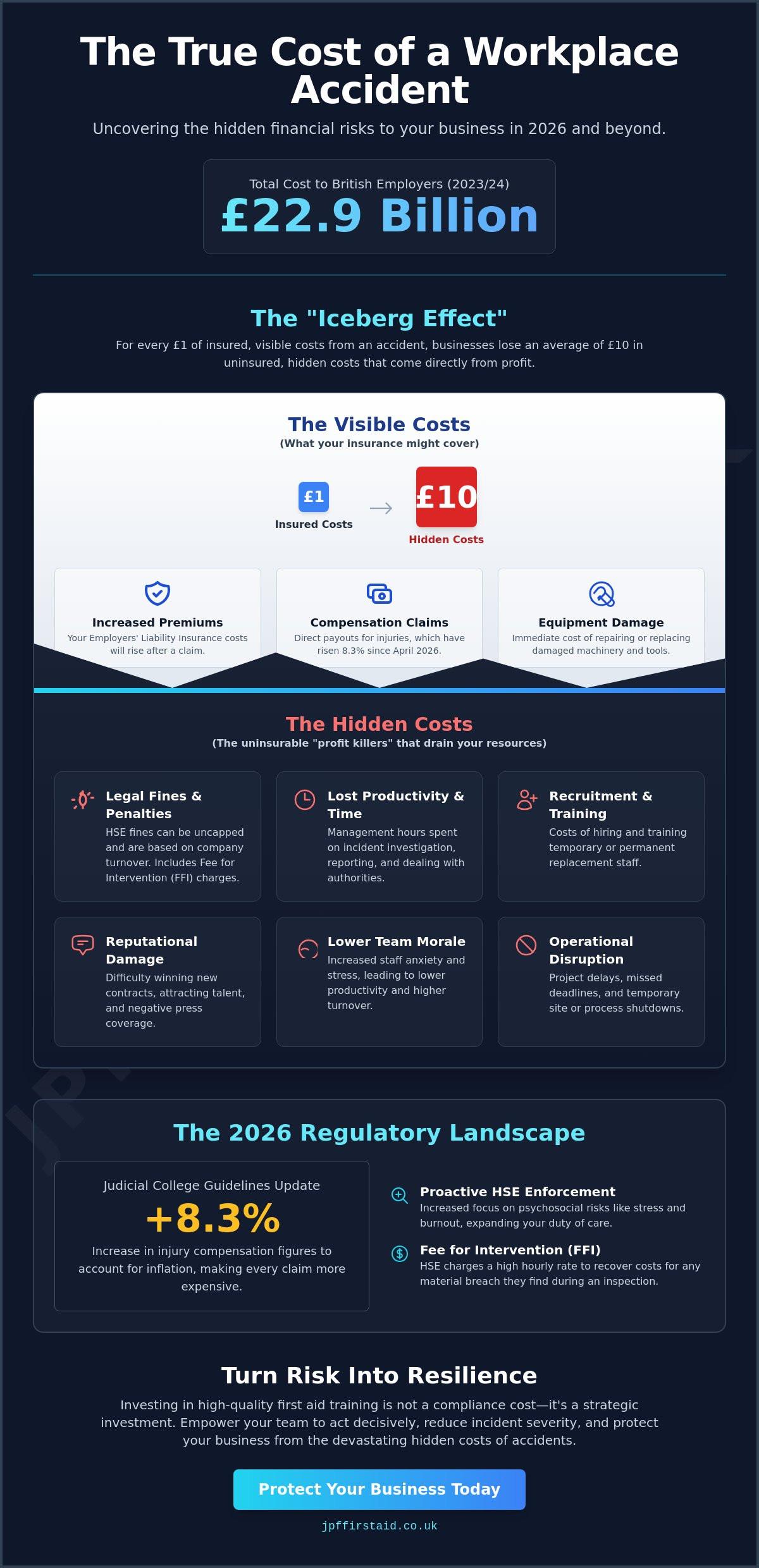
Did you know that workplace incidents cost British employers a staggering £22.9 billion in the 2023/24 period? It is a sobering figure, especially when you consider that the 18th edition of the Judicial College Guidelines, published in April 2026, increased compensation figures by 8.3 percent to account for inflation. When you are calculating the cost of a workplace accident uk, you’re likely already aware of the immediate legal fees and rising premiums. However, the “Iceberg Effect” means that for every £1 spent on visible costs, your business often loses another £10 in hidden operational disruption. It’s difficult to feel confident in your safety strategy when you aren’t sure of the true financial liability hiding beneath the surface.
We’re here to help you gain clarity and protect your bottom line. This guide provides a clear framework to identify both direct fines and those elusive productivity losses that drain your resources, giving you the data needed to justify investment in high-quality training. You’ll learn exactly how to measure the impact of recent legislative shifts, including the Employment Rights Act 2025 and new fire safety regulations. We will walk you through the essential steps to ensure your business remains compliant, safe, and financially resilient in 2026.
Key Takeaways
- Understand the “Iceberg Effect” and why your insurance policy only covers a small fraction of the total financial liability following an incident.
- Access a practical, step-by-step framework for calculating the cost of a workplace accident uk using the latest HSE incident cost models.
- Identify the “hidden profit killers” such as lost productivity and team morale that often lead to business failure after a major accident.
- Learn how to reframe regulated first aid training as a strategic profit centre that actively reduces the severity and financial impact of injuries.
- Stay ahead of 2026 legal requirements to protect your business from uncapped fines and ensure your safety budget is spent effectively.
The Iceberg Effect: Why Workplace Accident Costs are Deceptive
Most business owners view health and safety as a necessary expense, but it’s often only after a slip, trip, or fall that the true financial weight becomes apparent. According to the Health and Safety Executive (HSE), the total economic burden of workplace injuries and ill health in Great Britain reached £22.9 billion in 2023/24. This isn’t just a national statistic; it’s a direct threat to your company’s operational stability. When you’re calculating the cost of a workplace accident uk, you have to look far beneath the surface to see the full picture.
Visible Costs vs. Submerged Liabilities
Your Employers’ Liability Insurance is designed to catch the big, obvious hits. It typically covers injury claims and significant damage to plant or equipment. These are the “visible” costs, the tip of the iceberg that sits above the waterline. However, insurance only covers a small fraction of the total liability. The Iceberg Effect is the ratio of 1:10 between insured and uninsured losses. This means for every £1 you recover from an insurance claim, your business likely pays £10 out of its own pocket in unrecoverable expenses.
These submerged liabilities are often uninsurable and can include:
- Legal Fines: HSE fines are often based on turnover and can be uncapped.
- Lost Time: The hours spent by managers investigating the incident and filing reports.
- Recruitment: The cost of hiring and training temporary or replacement staff.
- Reputation: Damage to your brand that makes it harder to win new contracts or attract talent.
When we look at Occupational injury statistics, it’s clear that the 680,000 non-fatal injuries reported in 2024/25 create a massive ripple effect of hidden costs that insurance simply cannot touch.
The 2026 UK Regulatory Landscape
The HSE is more proactive in 2026 than ever before. Enforcement priorities have shifted toward mental health and psychosocial risks, meaning your duty of care now extends to managing stress and burnout as core safety issues. If an inspector finds a “material breach” of health and safety law at your site, they’ll charge you under the Fee for Intervention (FFI) scheme. This isn’t a one-off fine; it’s an hourly rate for the time the HSE spends identifying the breach and helping you rectify it. These costs add up quickly and come straight off your bottom line.
Shifting your mindset from “compliance cost” to “risk investment” is the best way to protect your business. You aren’t just buying a certificate or ticking a box for a regulator. You’re building a buffer against a £22.9 billion problem. Investing in high-quality training ensures your team has the confidence to act, reducing the severity of incidents before they spiral into the deep, submerged costs of the iceberg. To understand how professional consultancy can strengthen your strategy, you can learn more about Guardian Safety and their approach to workplace wellbeing.
Direct Costs: The Immediate Financial Impact
When an incident occurs, the first thing you’ll notice is the immediate drain on your cash flow. These are the “tip of the iceberg” expenses we discussed earlier. According to HSE cost of workplace injuries data, employers directly bore £4.3 billion of the total national safety bill in 2023/24. Calculating the cost of a workplace accident uk starts with these visible figures; the ones that show up on invoices and bank statements almost immediately after a tragedy or mishap.
HSE Fines and Legal Penalties
Under current Sentencing Guidelines, fines for health and safety breaches are linked directly to your company’s annual turnover and the level of culpability. This means a large organisation could face millions in penalties even for a single failing. In 2026, the HSE continues to use the Fee for Intervention (FFI) scheme to recover costs for any material breach found during an inspection. It’s a high hourly rate that applies from the moment the inspector identifies a problem until the issue is resolved. Imagine a minor slip on a wet floor that wasn’t properly signed. If the HSE investigates, you’re not just looking at a potential fine; you’re paying for their professional time to tell you what went wrong.
Compensation and Insurance Premiums
The 18th edition of the Judicial College Guidelines, published in April 2026, introduced an 8.3 percent increase in recommended compensation figures to account for inflation. This makes every claim significantly more expensive than it was just two years ago. While your Employers’ Liability Insurance covers the payout, it won’t protect you from the inevitable rise in your annual premiums. You also have to consider your sick pay obligations. Whether you pay Statutory Sick Pay (SSP) or have a more generous occupational scheme, you’re paying for a staff member who isn’t there to do their job. This adds another layer of complexity when you are calculating the cost of a workplace accident uk for your annual budget.
Don’t forget the legal defence fees. Even if you’re eventually found not at fault, the cost of solicitors and expert witnesses can be substantial. Some businesses also choose to fund private medical assessments or treatments to get an employee back to work faster, which is an additional upfront cost. Taking a proactive approach with First Aid At Work (Level 3) training can help you manage these risks by ensuring your team is ready to respond correctly and document incidents accurately from the very first second.
Indirect Costs: The Hidden Profit Killers
While the direct costs we’ve discussed are painful, they are rarely the reason a business fails after a major incident. The real danger lies in the “hidden” expenses that insurance policies simply don’t cover. When you are calculating the cost of a workplace accident uk, you must account for the 40.1 million working days lost in 2024/25 due to work-related ill health and injuries. These aren’t just numbers on a spreadsheet; they represent a massive drain on your operational capacity and your team’s collective energy.
Administrative burden is one of the most immediate indirect hits. Every reportable incident requires a RIDDOR (Reporting of Injuries, Diseases and Dangerous Occurrences Regulations) filing and a thorough internal investigation. This often pulls your senior managers away from their primary duties for days. If you lose a skilled employee to a long-term injury, the recruitment and retraining process begins. In 2026, the cost of finding, vetting, and training a new hire to reach full productivity can be eye-watering, especially when you consider the loss of institutional knowledge that goes out the door with an experienced staff member.
Operational Disruption and Morale
Workplace accidents don’t happen in a vacuum. When an incident occurs, production often grinds to a halt. Machinery might be impounded for inspection, or entire sites may be cordoned off. Even after work resumes, you’ll likely face the “presenteeism” trap. This is where staff are physically present but emotionally disengaged due to fear or low morale. A team that doesn’t feel safe is a team that doesn’t perform. Furthermore, a poor safety record can be a “red flag” during tender processes. Many UK organisations now demand a clean HSE history before they’ll even consider your bid for a new contract.
The Mental Health Cost Ripple
We often focus on the physical injury, but the psychological impact on witnesses and colleagues is a significant financial burden. HSE data shows that 1.9 million workers suffered from work-related illness in 2024/25, with stress, depression, and anxiety making up a huge portion of those cases. Secondary trauma can lead to a spike in short-term absences across an entire department. Implementing a robust Mental Health First Aid strategy is a sensible way to manage this ripple effect. It gives your team the tools to support one another, helping to restore confidence and stability much faster than leaving things to chance.
The Calculation Framework: How to Measure Your Risk
Understanding that accidents are expensive is one thing; knowing exactly how much they’ll drain from your specific bank account is another. To get an accurate figure, you need a structured approach that moves beyond guesswork. When you are calculating the cost of a workplace accident uk, the Health and Safety Executive (HSE) offers two primary paths: the “Simple Cost” model and the more detailed “Incident Cost” model. While the simple model uses national averages to give you a quick estimate, the incident model requires you to dig into your own HR and finance data to find the true impact on your margins.
Step-by-Step Incident Costing
To build a realistic picture of your financial risk, follow this four-step methodology after any incident, no matter how small it seems at the time:
- Step 1: Tally immediate hours lost. Record the exact time lost by the injured person, the first aiders who treated them, and any witnesses who stopped work. Use their actual hourly wage plus overheads to find the real cost of this lost time.
- Step 2: Calculate management time. Track every hour your supervisors spend on internal investigations, RIDDOR reporting, and meetings with legal or insurance representatives. This is often the most undervalued part of the calculation.
- Step 3: Estimate the Productivity Gap. If you have to bring in temporary staff or ask others to work overtime to cover a recovery period, those extra wages are a direct hit. You must also account for the lower efficiency of a new hire while they learn the ropes.
- Step 4: Apply the Iceberg multiplier. Take your total for the first three steps and multiply it. As we established earlier, the ratio of insured to uninsured losses is typically 1:10. This gives you a “Risk Ceiling” that represents your total potential liability.
Industry-Specific Multipliers
Your sector significantly changes the weight of these indirect costs. In construction and manufacturing, the ratio can be even higher than 1:10 because a single accident can stop an entire production line or shut down a site, leading to massive contract penalties. In contrast, office-based businesses in 2026 face rising costs from ergonomic injuries and work-related stress. While these might not involve a dramatic “event,” the cumulative cost of long-term absence is a major threat to profitability. Reviewing our First Aid Courses guide will help you identify which specific training levels match the unique risks of your industry.
Setting a “Risk Ceiling” helps you move from reactive panic to proactive management. It gives you a concrete number to present to your board when justifying the budget for safety equipment or staff development. If you’re ready to lower that ceiling and build a more resilient workforce, book a bespoke training session with our expert team today to ensure your staff have the skills and confidence to prevent these costs from ever reaching your bottom line.
The ROI of Prevention: Why Training is a Profit Centre
If you’ve spent time calculating the cost of a workplace accident uk, the figures can feel quite daunting. Between the £22.9 billion national economic burden and the recent 8.3 percent rise in compensation guidelines, the financial stakes are higher than ever in 2026. However, it’s time to shift the narrative. High-quality first aid training shouldn’t be viewed as a “tick-box” compliance expense. Instead, it’s a strategic financial strategy that protects your margins and builds a more resilient workforce. When your team knows exactly how to respond, they don’t just save lives; they save your business from the deep, submerged costs of the “Iceberg Effect.”
Reducing Severity Through Expert Training
The difference between a minor injury and a RIDDOR-reportable incident often comes down to the first ten minutes of care. For example, the immediate and correct treatment of a 3rd-degree burn can significantly reduce tissue damage and recovery time compared to a delayed or incorrect response. Confident first aiders act as a vital first line of defence, often preventing “minor” incidents from escalating into long-term absences or expensive legal claims. By investing in Emergency First Aid at Work, you ensure your staff have the practical skills to mitigate risks the moment they arise. This rapid intervention is the most effective way to keep your “Risk Ceiling” low and your productivity high.
Building a Resilient Workplace Culture
There’s a direct link between the quality of your safety training and employee loyalty. In 2026, workers value their wellbeing more than ever. When you provide training that is “engaging and fun” rather than dry and clinical, you send a clear message that you care about their success and safety. This builds a culture of confidence where staff feel empowered to look out for one another, reducing the likelihood of the stress and secondary trauma we discussed in previous sections. We find that bespoke on-site training is far more cost-effective than sending staff to generic off-site courses. It’s hassle-free, tailored to your specific workplace hazards, and ensures that everyone learns in the environment where they’ll actually use their skills.
At JPF First Aid, we pride ourselves on being your “Reliable Expert Mentor.” We move beyond the theory to give your team the “can-do” attitude needed to handle any emergency with calm competence. By choosing us as your partner in risk mitigation, you’re not just buying a certificate; you’re securing first aid training you can trust to protect your people and your profits. If you’re ready to transform your safety culture and safeguard your bottom line, Book your on-site training bundle today and experience the peace of mind that comes with true compliance.
Securing Your Business Stability for 2026 and Beyond
We’ve explored the £22.9 billion reality of workplace incidents and why insurance only covers the visible tip of the iceberg. By now, you understand that calculating the cost of a workplace accident uk requires looking deep into hidden productivity gaps and mental health ripples. You have the framework to audit your risk and the data to prove that prevention is a strategic profit centre rather than just a compliance expense.
Taking a proactive stance doesn’t have to be overwhelming. As a multi-award-winning training provider, we offer Ofqual regulated qualifications delivered with a relaxed, “can-do” attitude. We bring our expertise directly to you with on-site flexibility for groups of up to 12 learners, ensuring the training is practical, engaging, and relevant to your specific environment. Protect your business and your team with award-winning First Aid training today. You’ve done the hard work of understanding the risks; now let’s build the confidence to manage them together.
Frequently Asked Questions
Is an employer always liable for the cost of a workplace accident in the UK?
Not necessarily, but the burden of proof is high. Under the Health and Safety at Work Act 1974, you must prove you took all “reasonably practicable” steps to ensure safety. If an employee acted in gross misconduct against clear, documented training, liability might be reduced. However, you’ll still face the indirect costs of investigation and disruption regardless of the legal outcome.
How much are HSE Fee for Intervention (FFI) costs in 2026?
The FFI rate for the 2025/26 financial year is £174 per hour. This charge applies whenever an HSE inspector identifies a material breach of health and safety law during a visit. The clock starts from the moment they identify the fault and continues through the time spent investigating and writing reports. It’s a significant factor when calculating the cost of a workplace accident uk for your budget.
Does my Employers’ Liability Insurance cover HSE fines?
No, your insurance policy won’t cover criminal fines or HSE penalties. It’s actually illegal for an insurance company to pay a fine resulting from a criminal conviction or an FFI invoice. Your policy covers the compensation awarded to the injured party and your legal defence costs, but the financial sting of the fine itself comes directly from your company’s profits.
What is the average cost of a non-fatal workplace injury to a UK business?
While costs vary by severity, the HSE estimated that the average employer cost for a non-fatal injury was £1,400 in 2023/24 prices. This figure only includes immediate costs like sick pay and property damage. When you factor in the 1:10 indirect cost ratio we discussed earlier, the actual hit to your business operations is likely closer to £14,000 for a single reportable incident.
How does Mental Health First Aid training reduce business costs?
This training reduces costs by tackling the 1.9 million cases of work-related ill health reported in 2024/25. By identifying signs of stress or anxiety early, your supervisors can intervene before a staff member requires long-term leave. This proactively lowers your absence rates and prevents the “presenteeism” that drains productivity, keeping your team focused and your recruitment costs down.
What happens if I cannot afford to pay an HSE fine?
The court will assess your company’s financial health, but they won’t simply waive a fine because it’s high. Sentencing guidelines mean fines are proportional to turnover to ensure they have a “real economic impact.” If you can’t pay immediately, the court might allow for a payment plan, but significant health and safety failings can lead to insolvency for smaller businesses that haven’t prioritised compliance.
Can I calculate the cost of a “near miss” to prevent future accidents?
Yes, you can calculate the cost of a near miss using the same “lost time” methodology used for management investigations. While there’s no injury claim, the time spent investigating a near miss is an investment in preventing a future tragedy. Tracking these figures helps you justify the ROI of proactive training like Manual Handling or Fire Safety before a real accident occurs.
How often should I refresh first aid training to maintain compliance and reduce risk?
You must refresh your full First Aid at Work qualification every three years to remain compliant. However, the HSE strongly recommends annual “skills refreshers” to keep knowledge sharp. Regular training ensures your team maintains the confidence to act quickly, which is the most effective way to lower the severity of injuries when calculating the cost of a workplace accident uk for your insurance provider.
Recent Comments