

What if the only thing standing between your business and a heavy HSE penalty is a single staff member who isn’t quite sure what they’re supposed to do? You already understand that keeping your team safe is the most important part of your day. It’s natural to feel some anxiety about legal repercussions or confusion over how first aid appointed person responsibilities differ from those of a fully qualified first aider. With the HSE reporting 561,000 non-fatal workplace injuries in 2022/23, the pressure to get your compliance right for 2026 is higher than ever.
We’re here to replace that worry with a calm, “can-do” attitude. This guide promises to give you total clarity on your legal duties, from equipment management to emergency protocols. You’ll gain the confidence to handle professional services and ensure your workplace meets every current requirement. We’ll walk you through a practical checklist of duties and clear up common kit maintenance myths, so you can lead your team knowing you’re in safe, expert hands.
Key Takeaways
- Discover why the Health and Safety (First-Aid) Regulations 1981 make this role a mandatory minimum for every UK business, regardless of your company size.
- Gain clarity on the four core first aid appointed person responsibilities, from maintaining your emergency equipment to taking charge when an injury occurs.
- Identify the vital “Hands-Off” distinction between an appointed person and a first aider to ensure your workplace remains fully compliant and safe.
- Learn how to select the right team member for the role based on temperament and why a formal Letter of Appointment is essential for your records.
- Find out how a simple 1-day training course can provide the competence and “can-do” confidence needed to handle workplace emergencies without feeling overwhelmed.
What is a First Aid Appointed Person? Definition and Legal Standing
Every UK business owner holds a legal duty to protect their staff, and the Health and Safety (First-Aid) Regulations 1981 set the clear standard for this. At its most basic level, an appointed person is someone chosen to take charge of first aid arrangements. They aren’t necessarily trained to perform life-saving medical procedures, but they ensure that if someone falls ill or gets hurt, the wheels of your safety plan start turning immediately. It’s the minimum requirement for every single workplace in the UK, even if you only employ one or two people in a low-risk office environment.
The role exists to bridge the gap in workplaces where a full, three-day qualified first aider isn’t legally required based on a risk assessment. You don’t want to be left in a situation where a colleague is injured and nobody knows where the bandages are or who should call the ambulance. By naming an individual, you’re fulfilling your legal “duty of care” and ensuring that your organisation remains 100% compliant with current HSE standards. It’s a role built on reliability rather than complex clinical knowledge.
The Core Purpose: Taking Charge of Arrangements
There’s a vital distinction between providing “treatment” and managing “arrangements.” A qualified first aider is there to treat injuries, while an appointed person is there to manage the situation. This includes keeping the first aid kit stocked, replacing expired items, and taking charge when an emergency occurs. They are the backbone of safety for small businesses because they provide a calm, designated point of contact during a crisis.
You must ensure this person is “always available” during working hours. If your only appointed person is on annual leave or out on a site visit, you’re technically failing your legal obligations. Many smart businesses choose to appoint two people to cover holidays and sickness. This simple step removes the anxiety of being caught out and ensures your team feels supported every day of the week.
HSE Requirements for 2026: What the Law Says
As we move through 2026, the HSE continues to emphasise that first aid appointed person responsibilities are non-negotiable. While the law describes the training for this specific role as “non-mandatory” in very low-risk settings, there’s a paradox here. The HSE still expects the person to be “competent.” If an incident happens and your appointed person freezes because they’ve never seen a bandage, your business could face significant legal scrutiny. Most professional organisations now opt for a half-day or one-day basic skills course to provide that necessary confidence.
- Legal Requirement: Every workplace must have at least one appointed person if a full first aider isn’t present.
- Equipment: They must ensure the first aid box is easily accessible and correctly stocked.
- Emergency Protocol: They are responsible for calling 999 or 111 and handing over information to paramedics.
- Consequences: Failing to name an appointed person can lead to HSE improvement notices or fines during a routine inspection.
Choosing the right person shouldn’t feel like a chore. It’s about finding someone in your team who is organised, stays calm under pressure, and cares about their colleagues’ wellbeing. When you get this right, you create a safer, more professional environment where everyone knows they’re in safe hands.
The 4 Essential First Aid Appointed Person Responsibilities
Being an appointed person is about more than just holding a title; it’s about being the steady hand your team relies on when things go wrong. While you aren’t required to have the same level of intensive medical training as a standard first aider, your first aid appointed person responsibilities are the backbone of workplace safety. You ensure the infrastructure is there to save lives and that the transition from a workplace accident to professional medical care is seamless.
Equipment Management and Kit Auditing
You don’t want to find an empty box or an out-of-date bandage when an accident happens. A primary part of your role involves conducting a monthly audit of all first aid kits to ensure they meet BS 8599-1 standards. Check that sterile dressings are still sealed; once a package is torn or damp, it’s no longer sterile and must be replaced immediately. Most sterile items have a five-year shelf life, so keeping a simple log of expiry dates prevents a compliance failure. You should also ensure that first aid signage is clean, unobstructed, and visible from at least 20 metres away, directing people to the nearest kit or station without delay.
Taking Charge in an Emergency Situation
When an emergency strikes, you act as the “hands-off” responder. This means your focus is on managing the scene rather than necessarily performing clinical interventions. You’ll clear the area of bystanders, ensure the casualty has privacy, and make the environment safe for both the victim and arriving paramedics. Implementing the Role: A Practical Strategy shows how vital this coordination is in large organisations. When you call 999, have the exact postcode and a specific entrance point ready. If your site is large, you might even send a colleague to the gate to wave the ambulance in. If you want to build the skills to handle these high-pressure moments, our practical first aid courses offer the perfect confidence boost.
Record Keeping and Legal Documentation
Every incident, no matter how small, must be documented in the BI 510 accident book. This isn’t just bureaucracy; it’s a legal requirement that protects both the employee and the business. You must understand the Reporting of Injuries, Diseases and Dangerous Occurrences Regulations 2013 (RIDDOR). For example, if a workplace injury results in an employee being unable to perform their normal work duties for more than seven consecutive days, you must report this to the HSE within 15 days. Because these records contain sensitive medical data, you must store them in a secure, locked location to comply with the Data Protection Act 2018. Handling first aid appointed person responsibilities with this level of detail ensures your business stays on the right side of the law while keeping everyone safe.
Appointed Person vs. First Aider: Which Does Your Business Need?
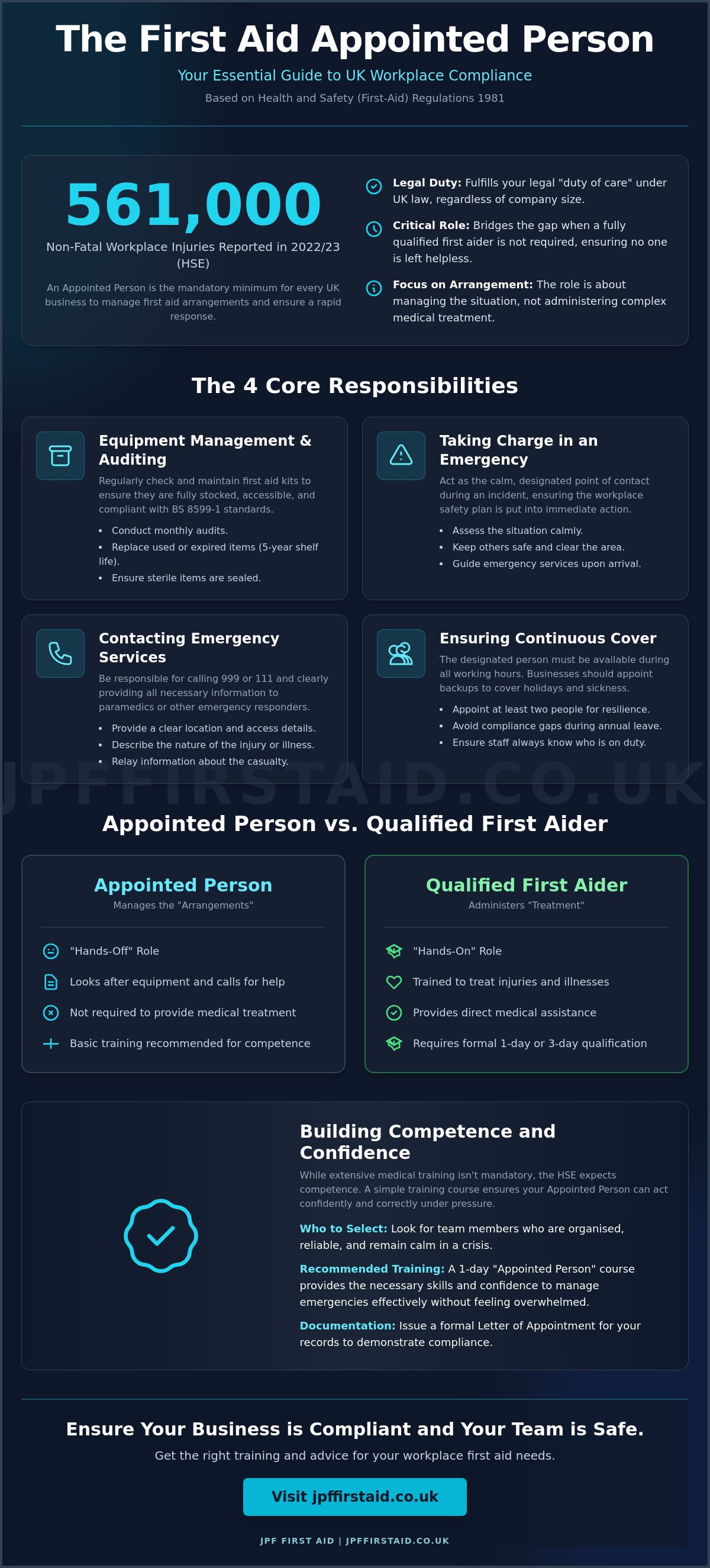
Choosing between an appointed person and a trained first aider isn’t just about ticking a box for the Health and Safety Executive (HSE). It’s about ensuring your team feels safe and supported while you stay compliant with the Health and Safety (First-Aid) Regulations 1981. The main difference lies in the “hands-on” versus “hands-off” approach to medical care. An appointed person takes charge of the situation, while a first aider provides the physical treatment.
Your first aid appointed person responsibilities focus on the administrative and emergency management side of safety. They look after the first aid kit, restock supplies, and call 111 or 999 when an accident occurs. Crucially, they aren’t required to have formal medical training to provide treatment. A first aider, however, holds a regulated qualification. They have the confidence to perform CPR, use an AED, or manage heavy bleeding. To decide which role fits your workplace, you must conduct a First Aid Needs Assessment. This document looks at your specific risks, the layout of your building, and your history of accidents.
Many small business owners find that dual-qualification is the most efficient path. When one person holds both roles, they have the authority to manage the equipment and the skills to save a life. This creates a seamless response that can save vital seconds during a cardiac arrest or a serious fall.
When an Appointed Person is Sufficient
An appointed person is usually the minimum legal requirement for low-risk environments. If you run a small office, a local library, or a retail shop with fewer than 25 employees, this role might be all you need. They act as the emergency point of contact. This person also plays a vital role in larger companies by stepping in when a qualified first aider is on annual leave or out of the office on a site visit. They ensure the first aid box is never empty and that emergency services are guided to the correct entrance when they arrive.
When a Level 3 First Aider is Mandatory
In high-risk industries, the stakes are much higher. If your team works in construction, manufacturing, or with hazardous chemicals, a qualified first aider is a legal necessity. You also need them if you have a large workforce where the statistical risk of an incident increases. For these settings, you should look into Emergency First Aid at Work training. This ensures your staff have the practical skills to manage incidents until the paramedics take over. Don’t leave your compliance to chance. Having a trained professional on-site builds a culture of care and gives everyone the confidence to work safely.
Implementing the Role: A Practical Strategy for Employers
Choosing someone to handle first aid appointed person responsibilities shouldn’t be a random selection. It’s a strategic decision that directly impacts your team’s safety and your company’s legal standing. You’re looking for a person who remains steady when things go wrong and can act as a reassuring presence for others.
Choosing the Right Candidate
Reliability is your first priority. Your appointed person must be someone who is consistently present and easily reached during working hours. While they don’t need the intensive clinical knowledge of a fully qualified First Aider, they do need excellent communication skills to liaise with emergency services. You’re looking for a “calm head” who won’t panic during a 999 call. Someone who is naturally organised will also find it easier to manage the routine aspects of the role, such as stock-checking the first aid box.
The biggest hurdle for most UK businesses is the “always on-site” rule. The Health and Safety (First-Aid) Regulations 1981 stipulate that first aid provision must be available at all times while people are at work. If your business operates on a shift pattern or has remote workers, a single person won’t suffice. You’ll need to appoint multiple people to cover holidays, sickness, and different site locations. For businesses with over 50 employees, maintaining a 15% “buffer” of trained staff ensures you’re never left vulnerable during flu season or peak holiday periods.
Policy and Communication
Once you’ve selected your candidate, formalise the role with a “Letter of Appointment.” This document clearly outlines their specific duties, from checking the expiry dates on bandages to being the primary contact for the ambulance service. It provides the individual with the authority they need to manage first aid kits and take charge during an incident. It also ensures there’s no confusion about where their role starts and ends.
Integrate these first aid appointed person responsibilities into your main Health and Safety policy. Don’t let this document gather dust; review your needs assessment every 12 months or immediately following a “near miss” incident. According to 2024 workplace safety data, companies that review their policies after minor incidents see a 22% reduction in major accidents the following year. You can find detailed checklists for staying compliant by visiting our guide on First Aid Training West Midlands.
Visibility is the final step. If your team doesn’t know who to call in a crisis, your planning is wasted. Use clear signage in communal areas like kitchens and lifts. Ensure every new starter meets the appointed person during their first-day induction. Making safety a visible, conversational part of your culture takes the fear out of emergency response and builds genuine confidence across the workforce.
Ready to ensure your team is fully prepared and compliant? Book your bespoke on-site training session today and gain the peace of mind that comes from expert mentoring.
Training and Competence: Building Confidence for the Role
Legally, the Health and Safety Executive (HSE) doesn’t mandate formal qualifications for an appointed person. However, “no formal training” doesn’t mean you can walk in with zero knowledge. You’re the individual responsible for the first aid kit and the emergency calls. If a colleague collapses, you’re the one people look to for direction. Relying on instinct alone during a high-pressure incident is a risk most UK businesses can’t afford to take. You need to be ready.
Choosing a 1-day Emergency First Aid at Work (EFAW) course is the smartest way to bridge the gap between compliance and competence. It provides the practical skills needed to handle first aid appointed person responsibilities with poise. You’ll learn how to assess a scene, manage an unconscious casualty, and use a defibrillator. This hands-on experience replaces panic with a structured plan, ensuring you act decisively when every second counts. It turns a “designated person” into a confident responder.
Skills fade faster than you might think. Studies often show that CPR technique and knowledge can decline significantly within 6 to 12 months of training. In a low-incident environment, where you might not use your skills for years, annual refresher sessions are essential. Keeping your skills sharp ensures that your response is automatic and effective, rather than hesitant. We make these sessions engaging and relaxed, focusing on the practical “can-do” attitude that saves lives.
Beyond Compliance: The Value of Elective Training
Stepping beyond the bare legal minimum creates a much safer workplace culture. Understanding the Basic Life Support (BLS) algorithm allows you to recognize the early signs of cardiac arrest and take immediate action. This knowledge is the foundation of emergency care. To truly master these life-saving steps, you can explore our Basic Life Support Training. It’s a focused way to build the muscle memory required for effective chest compressions and rescue breaths.
Mental Health and Wellbeing for Responders
Taking charge during a medical crisis is emotionally taxing. You aren’t just managing a wound; you’re managing your own adrenaline and the anxiety of those around you. Post-incident support is a vital part of your first aid appointed person responsibilities. It’s okay to feel the weight of the role after the ambulance leaves. For a more holistic approach to workplace safety, our Mental Health First Aid course provides the tools to support both yourself and your colleagues through the psychological aftermath of an emergency.
Securing Your Workplace for 2026 and Beyond
Mastering the first aid appointed person responsibilities is about more than just meeting a legal requirement. It’s about ensuring your team feels safe and your business remains compliant with current UK health and safety standards. You now know that this role focuses on vital tasks like maintaining kits and coordinating emergency services, ensuring nothing is left to chance during a crisis. Having a dedicated person in place provides a reliable foundation for your entire safety strategy.
JPF First Aid offers the expert guidance needed to bridge the gap between theory and real-world confidence. Our multi-award-winning training is delivered by John Fogarty, who brings over 20 years of experience to every session. We provide Ofqual regulated qualifications that are practical and engaging, ensuring the learning process is never dry or intimidating. You’ll gain the skills to manage workplace incidents with a calm, professional approach that puts people first.
Book an Emergency First Aid at Work Course to empower your Appointed Person today
We’re ready to help you build a safer, more prepared workplace with training you can truly trust.
Frequently Asked Questions
Does a first aid appointed person need a certificate?
No, an appointed person doesn’t strictly need a formal regulated certificate by law. However, the Health and Safety Executive (HSE) strongly recommends that they attend a basic training course to understand the first aid appointed person responsibilities. Most UK businesses find that a short, engaging course builds the necessary confidence to manage kits and call emergency services effectively without feeling overwhelmed.
Can an appointed person give CPR or use an AED?
An appointed person shouldn’t perform CPR or use an AED unless they have received specific practical training for those life saving tasks. Their primary role involves taking charge of first aid equipment and calling 999 during an emergency. If you want your team to have these hands on skills, we recommend an Emergency First Aid at Work course to ensure they feel capable and ready to act.
How many appointed persons do I need for my business?
You need at least one appointed person if your workplace is low risk, such as a small office, and has fewer than 25 employees. For larger teams or higher risk environments, the Health and Safety (First-Aid) Regulations 1981 require more comprehensive coverage. You must always have enough cover to account for staff holidays, sickness, or shift patterns so your site is never left without a designated person.
What happens if an appointed person is not on-site during an accident?
If an appointed person is absent and there is no backup, your business may be failing its legal duty of care. You should always designate a deputy to cover absences like annual leave or unexpected illness. Having a clear plan ensures someone is always available to manage the first aid appointed person responsibilities, such as directing the ambulance to the correct entrance during a crisis.
Is an appointed person legally liable if something goes wrong?
It’s very unlikely an appointed person will be held personally liable if they act reasonably and within their role. Under UK law, the employer usually carries the legal responsibility for health and safety compliance and vicarious liability. We focus our training on building your confidence, ensuring you feel supported and capable of helping others without the fear of legal repercussions or clinical mistakes.
Can an appointed person administer medication like aspirin?
No, an appointed person shouldn’t give out medication like aspirin or paracetamol as part of their standard duties. First aid kits in the UK shouldn’t contain tablets or medicines because of the potential risk of allergic reactions. Your role is to keep the casualty safe and comfortable until professional medical help arrives, rather than providing clinical treatments or pharmaceutical advice.
How often should an appointed person check the first aid kit?
You should check your first aid kit at least once a month to ensure everything is in date and fully stocked. Many sterile items like wipes and bandages have expiry dates, typically lasting between 3 to 5 years depending on the manufacturer. Regular checks mean you won’t face a stressful situation where you’re missing vital supplies when a workplace accident actually occurs.
What is the difference between an appointed person and a fire marshal?
An appointed person manages medical logistics while a fire marshal focuses on evacuation and fire prevention. While an appointed person looks after the first aid kit and emergency calls, a fire marshal checks fire extinguishers and leads people to assembly points. Both roles are vital for workplace safety, but they require different sets of practical skills and separate training to meet UK compliance standards.
Recent Comments