

What if the difference between a minor incident and a life-changing tragedy was just 60 seconds of clear, calm action? Most of us feel a genuine knot in our stomach when we think about a medical emergency. You want to help, but the fear of doing the wrong thing or getting tangled in complex medical jargon is a common barrier. It’s completely normal to feel confused about what are the first aid essentials you really need, especially with so many different workplace and paediatric regulations to consider.
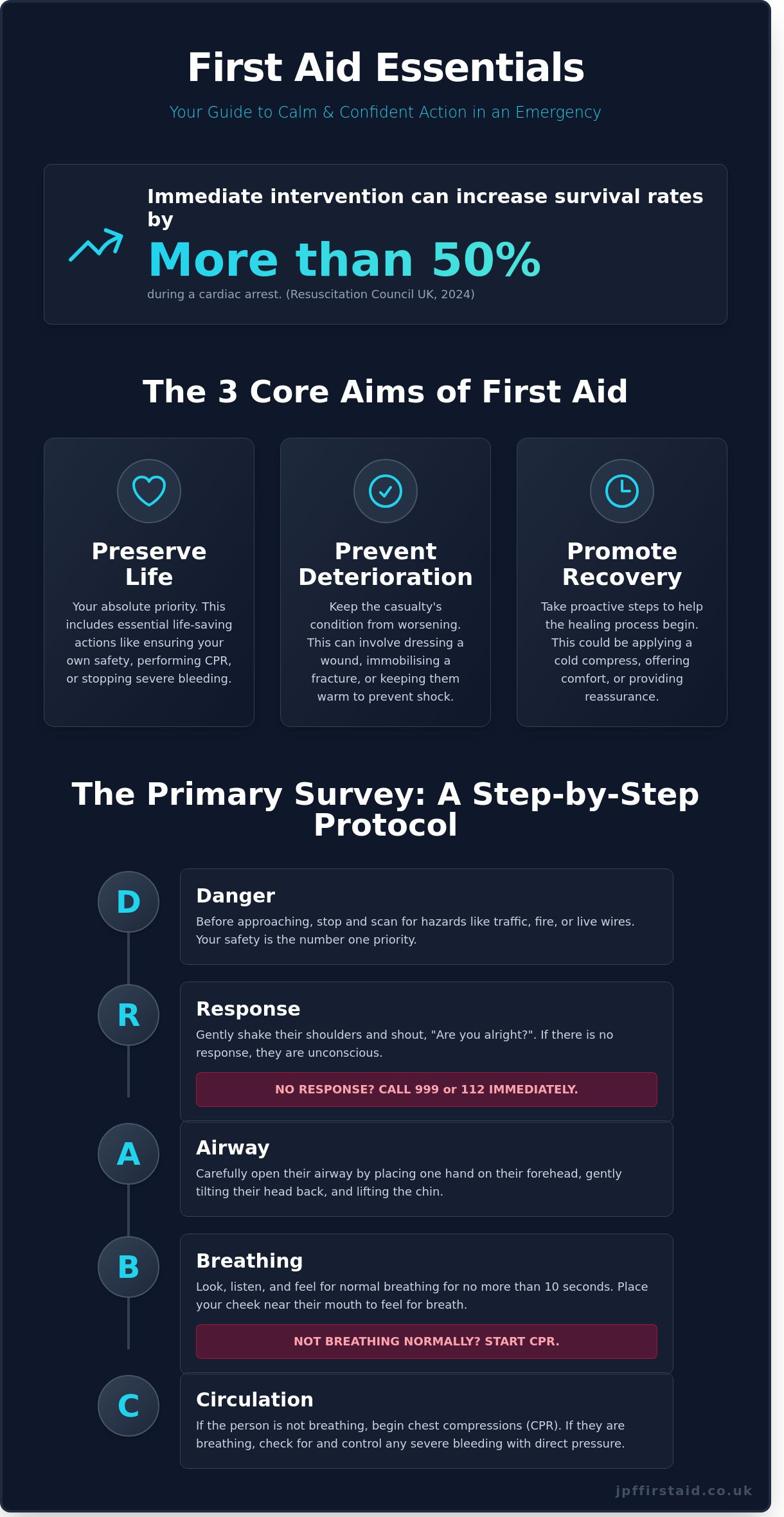
In 2024, data from the Resuscitation Council UK showed that immediate intervention can increase survival rates by more than 50% during a cardiac arrest. This guide provides the practical tools to be that vital link. You’ll master the fundamental “3 Ps” and the essential DRABC protocol, moving past the anxiety and into a “can-do” mindset. We’ll walk through the specific 2026 workplace requirements and help you identify exactly which regulated qualification is right for your needs, ensuring your training is both engaging and hassle-free.
Key Takeaways
- Understand the core “3 Ps” of immediate care to help you provide vital assistance and stabilise a casualty until professional medical help arrives.
- Master the DRABC protocol to assess emergencies safely and learn what are the first aid essentials required to manage a scene without putting yourself at risk.
- Gain practical skills for life-threatening scenarios, from managing severe bleeding with modern bleed kits to identifying and treating a choking casualty.
- Ensure your business meets the Health and Safety (First-Aid) Regulations 1981 by understanding your specific requirements for appointed persons and qualified first aiders.
- Build the confidence to act through engaging, regulated training that moves beyond theory to give you hands-on experience you can trust.
What is First Aid? Defining the “3 Ps” and Core Aims
When an accident happens at home, in the street, or at your place of work, the initial minutes are often the most critical. First aid is the immediate, temporary assistance you provide to someone who has suddenly become ill or injured. It isn’t about being a doctor or a highly trained paramedic; it’s about being the person who steps up to offer vital care until professional medical help arrives. Understanding what are the first aid priorities helps you stay calm when things get chaotic, ensuring your actions are both effective and safe for everyone involved.
The core aims of any first aider are traditionally grouped into the “3 Ps.” These three principles guide every decision you make at the scene of an incident, helping you focus on what really matters during a crisis:
- Preserve Life: This is your absolute priority. It involves essential life-saving actions such as ensuring your own safety first, opening an airway, performing CPR, or stopping life-threatening bleeding. If the scene isn’t safe, you cannot help anyone.
- Prevent Deterioration: You want to keep the casualty’s condition from getting any worse. This might involve dressing a wound to prevent infection, immobilising a suspected fracture, or simply keeping a person warm to ward off the onset of shock.
- Promote Recovery: These are the proactive steps that help the healing process begin. It could be as simple as applying a cold compress to a minor burn or providing a comfortable place for the person to sit while they wait for help to arrive.
The Legal and Ethical Side of Helping
Many people in the UK hesitate to help because they fear legal repercussions, but the legal landscape is designed to support those acting in good faith. Under the Social Action, Responsibility and Heroism Act 2015, British courts must consider if a person was acting for the benefit of society when an incident occurred. While a “Duty of Care” exists for employers under the Health and Safety (First-Aid) Regulations 1981, the average bystander isn’t legally forced to help. However, if you do choose to assist, you must gain consent first. If the casualty is unconscious, consent is usually implied under the Mental Capacity Act 2005, allowing you to provide life-saving treatment without delay. Being honest and respectful is the best way to handle these ethical moments.
The Role of the First Aider
You are the vital bridge between the incident and the ambulance service. Your role starts with managing the scene to ensure it’s safe for you, the casualty, and any bystanders. You don’t need a medical degree to make a massive difference to someone’s survival. By providing clear, concise information to 999 operators and offering reassurance to the casualty, you reduce panic and improve overall outcomes. It’s about being a calm, capable presence in a stressful moment. You’ll find that your confidence grows once you understand what are the first aid steps required for different scenarios. Your job is to hold the fort, keep the person comfortable, and provide a detailed handover to the paramedics when they take over. This simple act of staying present and focused can be the difference between a quick recovery and a long-term injury.
The Primary Survey: Your Step-by-Step Emergency Protocol
When you encounter an accident, your adrenaline spikes. It’s a natural reaction, but it can make your mind race. The DRABC method provides a logical structure to keep you focused. Understanding what are the first aid priorities helps you act with confidence rather than panic. This systematic approach ensures you deal with life-threatening issues in the correct order, protecting both the casualty and yourself. It’s the same reliable framework used by paramedics and professional first aiders across the UK.
Danger and Response: The First 10 Seconds
Before you rush in, stop and scan. Look for immediate hazards like live wires, oncoming traffic, or fire. You can’t help if you become a casualty too. If the area is safe, check for a response. Use the “Shake and Shout” technique by gently shaking the person’s shoulders and asking loudly, “Are you alright?” or “Can you hear me?” If there’s no reaction, use the AVPU scale to assess consciousness. A person might be Alert, respond to Voice, respond only to Pain, or be completely Unresponsive. If they don’t move or speak, you must call 999 or 112 immediately. For those managing a team, following the Fundamentals of a Workplace First-Aid Program ensures your staff knows exactly who should make that call during an office emergency.
Airway, Breathing, and the Recovery Position
An unconscious person’s tongue can relax and block their airway. You need to perform the head-tilt, chin-lift manoeuvre to open it. Place one hand on their forehead and two fingers under the point of their chin, then gently tilt the head back. Once the airway is open, check for breathing for no more than 10 seconds. Look for chest movement, listen for breath sounds, and feel for air on your cheek. Don’t be fooled by “agonal gasps.” These are infrequent, noisy, or irregular gasps that occur when someone is in cardiac arrest. They aren’t normal breathing. If the casualty is breathing normally but remains unconscious, put them in the recovery position to keep their airway clear and prevent choking.
- Place the arm nearest to you at a right angle to their body.
- Pull the other arm across their chest, holding the back of their hand against their cheek.
- Pull the far knee up until the foot is flat on the floor.
- Gently pull the knee towards you to roll them onto their side.
The final stage is Circulation. Look for signs of life-threatening bleeding. If you see blood pumping or pooling rapidly, you must apply direct pressure immediately. Watch for signs of shock, such as pale, cold, clammy skin or a rapid, weak pulse. In 2023, data from the Health and Safety Executive (HSE) highlighted that quick intervention in the first few minutes significantly improves survival rates for workplace incidents. Learning these skills in a practical first aid course gives you the hands-on experience to handle these high-pressure moments. Knowing what are the first aid steps for circulation can prevent a serious injury from becoming a tragedy. By following this DRABC protocol, you’re not just a bystander; you’re a vital link in the chain of survival.
Common First Aid Scenarios: Essential Skills for Daily Life
You don’t need to be a medical professional to save a life. Most emergencies happen in the places where we spend the most time, like our homes, offices, or local parks. While having a well-stocked home first aid kit is a brilliant starting point, the real magic happens when you have the confidence to use it. When people ask what are the first aid skills that matter most, they’re usually looking for practical, hands-on techniques for the “big four”: choking, bleeding, burns, and heart-related crises.
Understanding what are the first aid priorities helps you stay calm when others might panic. By 2025, the UK government aims to ensure more public spaces have life-saving equipment, but your immediate actions in those first three minutes remain the most critical factor in a casualty’s recovery. Let’s look at how you can handle these common scenarios with a “can-do” attitude.
For international travelers, this preparedness is equally important. Attending a high-energy event in another country, for instance, means being in a large, unfamiliar crowd. While planning your trip and securing your spot through a service like Jasumo Tickets, it’s also wise to consider what you’d do in an emergency. The principles of first aid are universal.
Managing Choking and Airway Obstructions
Choking is a terrifying experience, but it’s usually manageable if you recognize the signs quickly. A mild obstruction means the person can still cough, speak, or cry. In this case, you should simply encourage them to keep coughing to clear the object themselves. If the obstruction becomes severe, they won’t be able to breathe or make any sound. This is when you must step in.
For adults and children over one year old, the sequence is clear. Give up to five sharp back blows between the shoulder blades using the heel of your hand. If the object doesn’t move, perform five abdominal thrusts by standing behind them and pulling your clenched fist inwards and upwards just above their belly button. For infants under 12 months, never use abdominal thrusts. Instead, lay them face down along your thigh and give five gentle back blows. If the casualty loses consciousness at any point, call 999 immediately and start CPR.
These principles also apply to our furry family members, as choking is a common vet emergency. While first aid is critical, preventative training can also help manage a dog’s behavior around potential hazards. For comprehensive canine guidance, many owners turn to resources like I Wuff You Dog Training.
Treating Wounds and Controlling Bleeding
Wounds generally fall into three categories: incisions from clean cuts, lacerations from torn skin, and punctures from deep objects. Your primary goal is to stop the flow of blood. Apply firm, direct pressure to the wound using a clean dressing or cloth. If the blood soaks through, don’t remove the first dressing. Simply add another one on top to maintain the pressure and help the blood clot.
By 2026, “bleed kits” containing haemostatic dressings and tourniquets will be as common as defibrillators in British city centres. These tools are essential for knowing how to handle a catastrophic bleed where pressure alone isn’t enough. While you wait for help, elevate the injured limb above the level of the heart if possible. Always monitor for shock, which can be just as dangerous as the wound itself. If the person feels cold, clammy, or dizzy, lie them down and keep them warm until the paramedics arrive.
Burns, Scalds, and Heart Conditions
For burns and scalds, the “20-minute rule” is the absolute gold standard for treatment. Run cool tap water over the affected area for at least 20 minutes. This doesn’t just soothe the pain; it actually stops the heat from continuing to damage deeper layers of tissue. Avoid using ice, butter, or creams, as these can lead to infection or further tissue damage.
Finally, you must understand the vital difference between a heart attack and a cardiac arrest. A heart attack is a “plumbing” issue where blood flow is blocked; the person is usually conscious and may experience chest pain or nausea. A cardiac arrest is an “electrical” issue where the heart stops pumping entirely. The person will be unconscious and won’t be breathing. For a heart attack, keep the person calm and call 999. For cardiac arrest, you must start CPR and use an Automated External Defibrillator (AED) immediately to give them the best chance of survival.
Workplace First Aid: Compliance, Kits, and Mental Health
Under the Health and Safety (First-Aid) Regulations 1981, every UK employer must provide adequate and appropriate equipment, facilities, and personnel to ensure their employees receive immediate attention if they are injured or taken ill at work. It’s not just a box-ticking exercise; it’s a legal safeguard that protects your team and your business reputation. When you ask yourself what are the first aid provisions required for your specific site, you’re starting a process that saves lives. These regulations apply to all workplaces, including those with fewer than five employees and the self-employed.
Assessing Your Workplace Needs
You must conduct a thorough first aid needs assessment to determine your specific requirements. This isn’t a one-size-fits-all approach. For a low-risk office with 25 staff, an Appointed Person might suffice. This individual doesn’t need formal first aid training but must be responsible for the kit and calling emergency services. However, for a high-risk construction site or a larger factory, you’ll need fully qualified first aiders.
Understanding the Emergency First Aid at Work (Level 3) requirements is vital here. The 1-day EFAW course is perfect for low-risk environments. It covers essential life-saving skills like CPR and wound management. For more complex settings, the 3-day First Aid at Work (FAW) qualification provides deeper training on a wider range of medical conditions and injuries. You should consider the nature of the work, the hazards present, and your staff numbers to decide which is right for you.
The Essentials of a First Aid Kit
Your kit should meet the British Standard BS 8599-1 to ensure compliance. A basic kit isn’t just a handful of plasters. A standard compliant kit usually includes:
- 20 individually wrapped sterile plasters of assorted sizes
- 2 sterile eye pads
- 2 triangular bandages
- 6 safety pins
- 6 medium and 2 large sterile unmedicated wound dressings
- 10 antiseptic wipes
- Disposable gloves
Check your stock every month. Out-of-date sterile items won’t protect your staff and can lead to non-compliance during inspections. Having the right tools on hand is a fundamental part of what are the first aid basics in any professional setting.
The Rise of Mental Health First Aid
Workplace safety has evolved. We now recognise that 1 in 4 people in the UK will experience a mental health problem each year. This makes Mental Health First Aid a critical component of modern health and safety. It’s about spotting the early signs of distress, such as changes in appetite, withdrawal from social interaction, or unusual irritability.
Trained staff use the ALGEE action plan: Approach, Listen non-judgementally, Give support, Encourage professional help, and Encourage other supports. Providing this level of care reduces absenteeism and fosters a truly supportive culture. If you’re based in the West Midlands, our Mental Health First Aid courses in Birmingham provide the practical tools your team needs to support each other effectively. We focus on building the confidence to have those difficult conversations, ensuring no one suffers in silence.
Building Confidence: Why Regulated Training is the Best Solution
Watching a video tutorial might give you a basic idea of how to help someone, but it cannot replicate the physical experience of saving a life. While you might search online for what are the first aid procedures for a specific injury, real-world application requires more than a search engine. Practical, regulated training is where theory meets reality. At JPF First Aid, we believe that learning should be engaging and fun. We move away from dry, clinical lectures and focus on interactive sessions that improve knowledge retention. When you enjoy the learning process, you’re 75% more likely to recall those vital steps during a high-pressure situation.
Choosing an Ofqual regulated qualification isn’t just about ticking a box for your employer. These certifications provide a standardised level of excellence that is recognised across the UK. For your CV, it’s a badge of reliability. For a business, it ensures 100% compliance with the Health and Safety (First-Aid) Regulations 1981. We make this process hassle-free for West Midlands businesses by bringing the training directly to your site. This eliminates travel time and allows your team to learn in the environment where they actually work, making the scenarios feel much more relevant.
Overcoming the Fear of Acting
The biggest hurdle in an emergency isn’t a lack of knowledge; it’s the fear of doing something wrong. Practical practice with modern manikins builds muscle memory that stays with you long after the course ends. You’ll learn exactly how much pressure is needed for chest compressions and how to clear an airway with confidence. We recommend regular refresher training every 12 months to keep these skills sharp and ensure your reactions remain instinctive. Confidence is the most important tool in your first aid kit.
Choosing Your Path: Which Course is Right?
Not every environment has the same risks, so your training shouldn’t be “one size fits all.” If you work in a nursery or school, a Paediatric First Aid course is essential to understand the physiological differences in treating children. For most offices and industrial sites, the First Aid at Work (FAW) or Emergency First Aid at Work (EFAW) courses are the standard requirement. We understand that your time is precious, which is why we offer flexible learning styles to suit your schedule.
- Adult First Aid: Ideal for general workplace compliance and high-risk environments.
- Paediatric First Aid: Specifically designed for those looking after infants and children.
- Blended Learning: A modern approach that combines independent online study with face-to-face, video-link assessments.
By tailoring the content to your specific needs, we ensure you walk away with skills that are actually useful. Whether you are a small local business or a large organisation, we provide the expert guidance you need to feel prepared. Don’t leave safety to chance or rely on outdated knowledge. You can book your bespoke first aid course with JPF First Aid today and gain the skills that truly make a difference in an emergency.
Take the Next Step Toward Saving Lives
Understanding the “3 Ps” and the Primary Survey isn’t just about ticking a box; it’s about having the confidence to act when every second counts. By now, you should have a clear grasp of what are the first aid essentials required to meet Health and Safety Executive (HSE) standards for 2026. Whether you’re managing a workplace kit or supporting a colleague’s mental health, these skills form the foundation of a safer community.
Reading a guide is a great start, but life-saving competence comes from hands-on practice. JPF First Aid is a multi-award-winning training provider delivering Ofqual regulated qualifications across Birmingham and the West Midlands. Our expert-led sessions are designed to be engaging and relaxed, ensuring you walk away with practical experience rather than just a certificate. We’ve simplified the process by offering bespoke, on-site training that fits your specific schedule and location.
Don’t leave emergency preparedness to chance. Get a bespoke quote for on-site first aid training today and gain the skills to protect your team and family. You’re ready to make a difference.
Frequently Asked Questions
What are the main aims of first aid?
The three primary aims of first aid are to preserve life, prevent the condition from worsening, and promote recovery. You focus on keeping the casualty stable until professional medical help arrives. By following these “3 Ps,” you provide a vital bridge between the accident and the hospital. Our training gives you the practical skills to handle these moments with a calm, can-do attitude.
Is first aid training a legal requirement for small businesses in the UK?
Yes, the Health and Safety (First-Aid) Regulations 1981 require every employer to provide adequate equipment and personnel. Even if you only have 1 employee, you must conduct a risk assessment to determine your needs. For many small offices, having at least one Appointed Person is the minimum legal baseline to ensure you remain compliant and your team stays safe.
How long does a first aid certificate last before it expires?
A standard regulated first aid certificate is valid for exactly 3 years from the date it was issued. After this 36-month period, your qualification expires and you’ll need to attend a requalification course to stay certified. The HSE recommends an annual 3-hour refresher because research shows that CPR skills can start to diminish only 6 months after your initial training session.
Can I be sued for giving first aid in the UK?
It’s extremely unlikely you’ll face legal action if you act reasonably and within the scope of your training. The Social Action, Responsibility and Heroism Act 2015 was specifically designed to protect bystanders who step in to help during emergencies. To date, no individual has been successfully sued in the UK for performing CPR in good faith. We’ll help you build the confidence to act without fear.
What is the difference between a First Aider and an Appointed Person?
A First Aider has completed a regulated 1-day or 3-day qualification, while an Appointed Person is simply someone chosen to manage first aid arrangements. The Appointed Person looks after the first aid box and calls 999 but doesn’t necessarily have formal clinical skills. If your risk assessment identifies specific hazards, you’ll need a fully qualified First Aider to meet your legal obligations and keep your staff protected.
What should I do if someone is having a heart attack?
You should call 999 immediately and help the person sit on the floor in a “W” position with their back supported. If they aren’t allergic, the NHS recommends they chew a 300mg aspirin slowly while waiting for the ambulance. Understanding what are the first aid steps for cardiac emergencies can improve survival rates by over 50% when you act quickly and stay calm.
How much does a private group first aid course cost?
A bespoke on-site Emergency First Aid at Work course for a group of up to 12 learners typically starts at £495 plus VAT. This equates to just £41.25 per person, which is a very cost-effective way to get your entire team trained at once. We bring all the equipment to your venue, so you don’t have the hassle or expense of sending staff to an external training centre.
Are paediatric first aid courses different from standard workplace courses?
Yes, paediatric courses focus specifically on infants and children, covering unique CPR techniques and illnesses like croup or meningitis. While standard workplace courses focus on adults, Ofsted and EYFS regulations require early years settings to have staff with a specific 12-hour Paediatric First Aid qualification. Knowing what are the first aid protocols for different age groups ensures you’re prepared for any situation in a school or nursery setting.
Recent Comments