

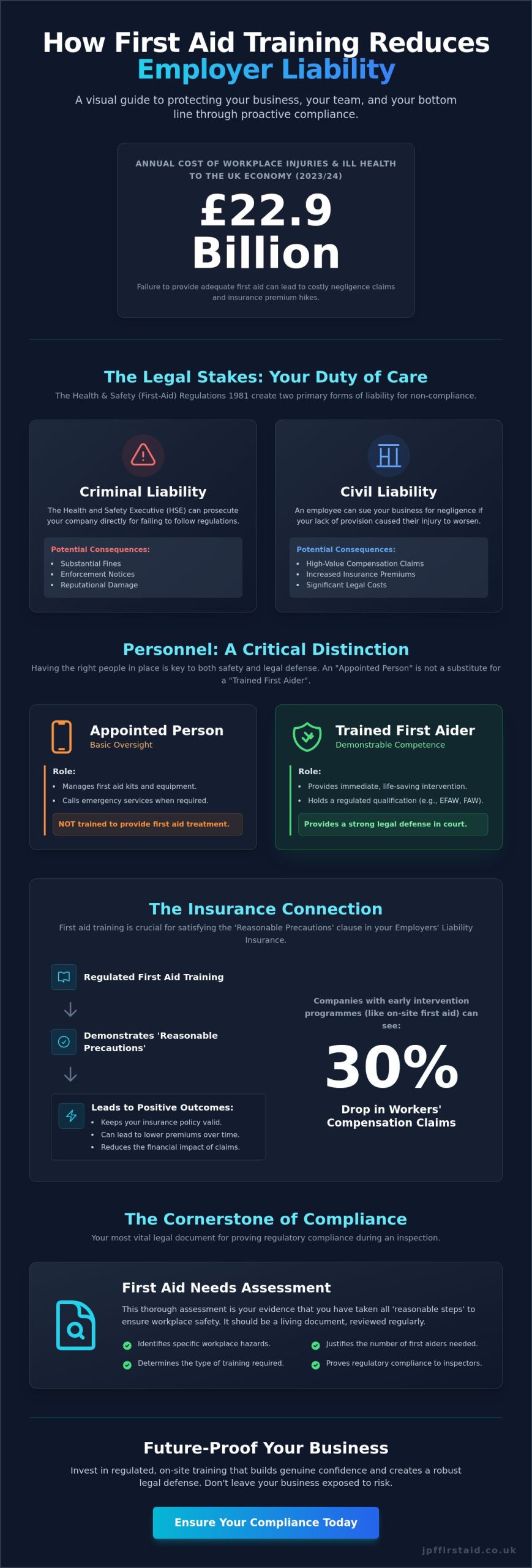
Did you know that workplace injuries and ill health cost the UK economy an estimated £22.9 billion in the 2023/24 period? If you’re a business owner, you likely worry about how a single accident could spiral into a costly negligence claim or a hike in your insurance premiums. It’s completely understandable to feel overwhelmed by the HSE requirement for “adequate and appropriate” first aid provision, especially when the legal stakes are so high.
We’re here to show you that meeting your obligations doesn’t have to be a headache. This guide explains exactly how first aid training reduces employer liability by acting as a robust legal defense for your company. You’ll discover how investing in regulated qualifications, such as Emergency First Aid at Work, helps prevent minor incidents from escalating into high-value litigation. We will also look at how prompt intervention can lower your risk profile and protect your bottom line, ensuring your workplace remains safe, compliant, and ready for anything 2026 throws your way.
Key Takeaways
- Understand your statutory obligations under the 1981 Regulations to ensure your business meets the essential “duty of care” for every staff member.
- Discover how first aid training reduces employer liability by satisfying the “reasonable precautions” clauses often required by Employers’ Liability Insurance providers.
- Learn how immediate workplace intervention can limit the severity of an injury, which directly reduces the financial impact of potential compensation claims.
- Identify why a thorough First Aid Needs Assessment is your most vital legal document for proving regulatory compliance during an inspection.
- Explore how bespoke, on-site training builds the genuine confidence your team needs to act decisively, rather than just holding a certificate.
Understanding the Legal Duty of Care: The 1981 Regulations
The Health and Safety (First-Aid) Regulations 1981 aren’t just a set of suggestions; they’re the primary statutory obligation for every business operating in the UK. As an employer, you have a legal duty of care to ensure your staff receive immediate attention if they’re injured or taken ill at work. This responsibility doesn’t end at simply having a kit in a cupboard. It requires you to provide adequate and appropriate equipment, facilities, and personnel. Understanding how first aid training reduces employer liability begins with recognising that failure to meet these standards leaves you open to two types of legal action.
First, there’s criminal liability. The Health and Safety Executive (HSE) can prosecute your company for failing to follow the 1981 Regulations, leading to substantial fines. Second, there’s civil liability. This occurs when an employee sues for negligence, claiming that your lack of provision caused their injury to worsen. With the annual economic cost of workplace injuries reaching £22.9 billion in 2023/24, insurers and courts are increasingly strict. In the eyes of the law, ignorance of the law is never a valid defence. Whether you’re a small boutique or a large factory, the courts expect you to be proactive in protecting your workforce.
The ‘Adequate and Appropriate’ Standard
The HSE defines “adequate” based on the specific risks of your workplace. There isn’t a single checklist that fits every company because a high-risk construction site has very different needs compared to a quiet accounting office. Adequate provision is a scalable requirement based on workforce size and hazard profile. If your risk assessment identifies specific dangers, like chemical burns or heavy machinery accidents, your first aid provision must match those risks. Doing the bare minimum is a common trap. If an accident occurs and your provision is deemed inadequate for the actual hazards present, your legal defence will likely crumble during a negligence claim.
Appointed Persons vs. Trained First Aiders
Many businesses mistakenly believe that having an “appointed person” is always enough. While an appointed person can manage first aid kits and call emergency services, they aren’t trained to provide life-saving treatment. In a courtroom, a Level 3 First Aid at Work qualification carries far more weight. It demonstrates that you’ve invested in a regulated standard of care. For lower-risk environments, an Emergency First Aid at Work course often provides the necessary baseline. By ensuring your team understands fundamental first aid principles, you create a safer environment and a much stronger legal shield. Ultimately, this proactive approach is exactly how first aid training reduces employer liability by proving you took every reasonable step to protect your staff.
The Relationship Between Training and Employers’ Liability Insurance
Employers’ Liability Insurance (ELI) is a legal necessity for almost every UK business, but it isn’t a blank cheque for negligence. When an accident happens and a claim is filed, your insurer will immediately look for evidence that you followed the Health and Safety (First-Aid) Regulations 1981. Most policies include a ‘Reasonable Precautions’ clause. This means the insurer expects you to take logical, proactive steps to prevent injury and minimise harm. If a claim arises and your first aiders’ certificates have expired, the insurer might argue you breached your policy terms, potentially leaving your business to foot the bill.
A robust training matrix is your best friend during annual risk assessments. By showing an insurer that 100% of your designated first aiders hold current, regulated qualifications, you demonstrate a lower risk profile. This is a primary way how first aid training reduces employer liability; it keeps your insurance valid and can even lead to lower premiums over time. Studies have shown that companies with early intervention programmes, including on-site first aid, can see workers’ compensation claims drop by 30% or more. Proving you took ‘all reasonable steps’ is much easier when you have a paper trail of high quality training.
Mitigating the Risk of Negligence Claims
In a civil court, a negligence claim usually rests on three pillars: Duty, Breach, and Causation. You already have a ‘Duty’ to your staff. A ‘Breach’ occurs if you fail to provide the standard of care expected of a reasonable employer. By choosing Ofqual regulated qualifications, you provide gold-standard evidence that no such breach occurred. It shows you didn’t just “tick a box” but instead provided training that meets rigorous national standards. This makes it incredibly difficult for a claimant to argue that your first aid provision was substandard or negligent.
Protecting Your Staff: The Good Samaritan Perspective
We often hear from business owners that their staff are afraid to help. They worry: “Can I be sued if I make a mistake?” It’s a valid concern that can lead to hesitation during a crisis. However, the Social Action, Responsibility and Heroism (SARAH) Act 2015 was specifically designed to protect people who act heroically to help others in an emergency. It requires judges to consider whether the person was acting for the benefit of society when a claim is made. Providing comprehensive first aid courses empowers your team with the skills they need, while also reducing their personal liability anxiety. If you want to build this level of confidence in your team, we can help you set up a bespoke training plan that fits your specific workplace risks.
Mitigating Damages: How Prompt First Aid Limits Claim Severity
In the UK legal system, the financial “quantum” of a personal injury claim is largely determined by the severity and duration of the injury. When an accident occurs, the clock starts ticking on your potential liability. Prompt intervention is the most effective tool you have for controlling these costs. By providing immediate care, your trained staff can often prevent a temporary injury from becoming a permanent disability. This direct link between medical speed and financial outcome is a core reason how first aid training reduces employer liability by capping the potential damages awarded in a civil court.
The “Golden Hour” is a well-known concept in emergency medicine, but it’s equally relevant to your risk management strategy. For example, using a defibrillator within the first few minutes of a cardiac arrest can increase survival rates from less than 10% to over 70%. From a liability perspective, a successful resuscitation resulting in a full recovery carries a vastly different legal and financial weight than a fatality or an incident resulting in long-term brain damage. Investing in high quality response is an integral part of managing workers’ compensation costs and protecting your business from six-figure payouts.
Consider the logic of the investment. The cost of a three-day First Aid at Work course is negligible when compared to the legal fees and settlement costs of a single negligence claim. In 2023/24, the estimated annual cost of workplace injuries was £22.9 billion. A business that can prove its first aiders acted decisively to mitigate harm is in a much stronger position to negotiate settlements or defend against claims of total negligence.
Preventing Secondary Injuries
Liability isn’t always about the initial accident; it’s often about what happens next. If an untrained employee attempts to move a casualty and causes further spinal damage, your business faces an “aggravated” injury claim. This is where manual handling training becomes essential. It ensures your team knows how to assist safely without worsening the situation. Trained first aiders understand their limits, which is vital for avoiding the common workplace liability trap of “well-intentioned but harmful” intervention.
The Impact of Mental Health First Aid
Modern liability isn’t just about physical breaks and bleeds. With 964,000 workers suffering from work-related stress, depression, or anxiety in 2024/25, psychological safety is now a major legal battleground. Implementing mental health first aid training shows that you take a proactive approach to employee wellbeing. It helps your supervisors spot the early warning signs of burnout, potentially preventing “failure to support” or constructive dismissal claims before they reach a tribunal. This holistic approach to safety is how first aid training reduces employer liability across every aspect of your operations.
Proving Compliance: Documentation and the First Aid Needs Assessment
Legal protection isn’t just about what you do in an emergency; it’s about what you can prove you did before the sirens ever sounded. In the eyes of an HSE inspector or a judge, if it isn’t documented, it didn’t happen. A written First Aid Needs Assessment is your most important legal document. It provides the logical rationale for every first aider you’ve trained and every kit you’ve installed. This document is exactly how first aid training reduces employer liability by showing you’ve carefully considered your specific risks rather than guessing at “adequate” provision.
You must justify your number of first aiders based on more than just total headcount. Consider your shift patterns. If an accident happens at 3:00 AM and your only trained responder works the day shift, your “adequate provision” vanishes. Your site layout matters too. If a worker is injured on the third floor of a warehouse, a kit in the ground floor reception is effectively useless. Keeping a ‘Training Matrix’ ensures you have instant proof of compliance during spot checks or following one of the 59,219 RIDDOR-reported incidents that occur annually in the UK. Recording ‘Near Misses’ in your first aid logs is equally vital. It helps you fix hazards before they cause a liability event.
Creating a Legally Robust Needs Assessment
A solid assessment follows a logical path. First, identify workplace hazards like machinery, chemicals, or working at heights. Second, consider your workforce. Do you have older employees, staff with pre-existing conditions, or inexperienced apprentices who need more supervision? Finally, account for non-employees. If your business welcomes customers, contractors, or visitors, your duty of care extends to them. This three-step approach builds a comprehensive shield against negligence claims.
The Importance of Re-qualification and Refreshers
Expired certificates are a major liability loophole. If a first aider’s qualification is out of date, they are technically no longer “competent” under the 1981 Regulations. This creates a clear “Breach of Duty” if they fail to provide the correct care during a crisis. Annual skills refreshers are highly recommended by the HSE to maintain competence. We know managing these dates is a chore for busy managers. At JPF First Aid, we take the hassle out of renewals by tracking your dates for you. You can book your First Aid At Work Re-qualification with us to ensure your business stays permanently protected and your team remains confident. This proactive management is another way how first aid training reduces employer liability by closing gaps in your legal defence.
Future-Proofing Your Business with JPF First Aid
Choosing the right training provider is the final, crucial step in your risk management strategy. While many companies offer basic compliance, we believe that “engaging and fun” training is the key to genuine safety. When your staff enjoy the learning process, they retain information far more effectively. This higher retention rate is directly linked to how first aid training reduces employer liability, as it ensures your team can actually perform life-saving skills when it matters most. By partnering with a multi-award-winning provider like JPF First Aid, you add a robust layer of due diligence to your safety records, showing stakeholders that you value quality over the cheapest “tick-box” option.
Our on-site group training takes this protection a step further. We don’t just teach generic theory; we come to you and customise scenarios to your specific workplace risks. Whether you’re managing a busy warehouse or a quiet office, our experts ensure the training feels immediate and relevant. This “Safety First” culture doesn’t just protect you in a courtroom. It helps you attract top talent who feel valued and reassures your clients that they’re in safe hands. In the competitive landscape of 2026, a proven commitment to safety is a powerful brand asset that goes beyond simple legal compliance.
The expertise we bring as your “Reliable Expert Mentor” means we focus on practicality over complex theory. We understand that business owners are busy, so we make the process hassle-free. From the moment you book until the certificates are issued, we handle the logistics so you can focus on running your company. This professional, streamlined approach is why we’re considered a trusted partner for businesses across the UK.
Confidence: The Missing Link in Liability Reduction
A certificate alone doesn’t save lives; the confidence to act does. Many people freeze during an emergency because they’re afraid of making a mistake that could lead to trouble. We focus on practical, hands-on skills that stick, ensuring your team feels empowered rather than intimidated by the gravity of the situation. By eliminating hesitation, a confident first aider reduces the “panic window” that often leads to critical errors and subsequent negligence claims. This shift from passive knowledge to active, calm confidence is the most effective way to ensure your first aid provision actually works when it’s needed.
Bespoke Training Solutions for Every Industry
Every industry has unique requirements that a standard course might overlook. We provide everything from paediatric first aid for schools and nurseries to high-risk industrial qualifications for manufacturing plants. Our flexible delivery, including blended learning and traditional classroom sessions, ensures your training fits around your business schedule without disrupting your daily operations. Don’t leave your legal protection to chance. Contact JPF First Aid today for a bespoke workplace training quote and build a safety shield you can trust.
Protect Your Business Future with Confident Care
You’ve discovered that effective risk management is about more than just meeting the bare minimum of the 1981 Regulations. It’s about ensuring your insurance remains valid through “reasonable precautions” and having a team that acts with speed and precision. By fully understanding how first aid training reduces employer liability, you can move from a position of anxiety to one of complete control. You’ve seen that the right documentation and up-to-date qualifications are your best defence against the rising costs of negligence claims and insurance premiums.
We’re here to make this process simple and stress-free. As a multi-award-winning training provider, we deliver Ofqual regulated qualifications that your staff will actually enjoy. Our sessions are designed to be engaging, practical, and fun, ensuring that confidence is the primary outcome for every learner. Book Your Regulated Workplace First Aid Training with JPF First Aid today to secure your site and support your team. You’re in expert hands, and we’ll ensure your business stays compliant, protected, and ready for the years ahead.
Frequently Asked Questions
Is it a legal requirement to have a trained first aider in the UK?
Yes, the Health and Safety (First-Aid) Regulations 1981 require every UK employer to provide adequate and appropriate first aid equipment, facilities, and personnel. Your specific needs are determined by a risk assessment. In most workplaces, this means having at least one person with a regulated qualification to ensure help is available if an employee is injured or taken ill.
Can an employer be held liable if a first aider makes a mistake?
You can be held liable if you haven’t provided the correct standard of training or if your provision is deemed inadequate. However, providing a regulated course through an expert provider is your strongest defence. It proves you’ve met your duty of care by ensuring the responder was competent and followed nationally recognised protocols at the time of the incident.
How many first aiders do I need for a staff of 50?
For a low-risk office with 50 staff, the HSE generally recommends at least one first aider trained in Emergency First Aid at Work. If your workplace is high-risk, such as a construction site, you’ll likely need one person trained in the full First Aid at Work qualification for every 20 employees. This tailored approach is exactly how first aid training reduces employer liability by ensuring your response matches your specific hazards.
What happens if my business is found to have ‘inadequate’ first aid provision?
Your business faces serious consequences, including criminal prosecution by the HSE and heavy fines. Additionally, you’re far more vulnerable to civil negligence claims from employees. With workplace injuries costing the UK economy £22.9 billion in the 2023/24 period, the financial and reputational damage of being found non-compliant can be devastating for any small or medium-sized enterprise.
Do I need first aid training for remote or lone workers?
Yes, your legal duty of care extends to every employee, regardless of their location. For lone workers or those who travel, you should provide a personal first aid kit and potentially basic training so they can manage minor injuries themselves. Failing to account for remote staff in your 2026 needs assessment is a common oversight that leaves your business legally exposed.
How often should workplace first aid training be refreshed to maintain legal compliance?
Full qualifications like the Level 3 First Aid at Work certificate expire after exactly three years. However, the HSE strongly recommends that first aiders attend a half-day annual refresher to keep their skills sharp. Maintaining this cycle is a primary way how first aid training reduces employer liability, as it prevents the skill fade that often leads to errors during a real-life emergency.
Does first aid training reduce my Employers’ Liability Insurance premiums?
While most insurers don’t offer a flat discount, it significantly improves your risk profile during annual reviews. A robust training record reduces the frequency and severity of claims, which is a key factor insurers use to set your rates. Some companies see a 30% reduction in claim costs simply by implementing early intervention programmes like on-site first aid.
What is the difference between a ‘First Aider’ and an ‘Appointed Person’ in the eyes of the law?
A first aider is someone who has passed a regulated qualification and can provide life-saving treatment. An appointed person’s role is much more limited; they only look after the first aid box and call 999 if an emergency occurs. In the eyes of the law, an appointed person isn’t trained to provide medical care. Relying on them in a high-risk setting is often seen as a breach of duty.
Recent Comments