

Imagine your designated first aider is finally taking that well-earned break in the sun, but back at the office, a team member has a serious fall. With 680,000 workers sustaining non-fatal injuries in 2024/2025, the risk is always present, even when your key people are away. You’re likely asking what happens if a designated first aider is on holiday and whether your business is still meeting its legal obligations under the Health and Safety (First-Aid) Regulations 1981. It is a common worry, but the good news is that compliance doesn’t have to be complicated or stressful.
We understand that managing staff rotas alongside strict HSE requirements can feel overwhelming, especially when you’re trying to balance training budgets with daily operations. You want to do right by your team, but the legal jargon often gets in the way. This guide will give you the clarity you need to maintain seamless first aid coverage, ensuring you stay compliant and your team stays safe every day of the year. We’ll walk through the essential needs assessment process, explain why holidays aren’t considered “exceptional circumstances,” and help you build a practical coverage plan that provides total peace of mind.
Key Takeaways
- Understand why the Health and Safety (First-Aid) Regulations 1981 require constant personnel coverage tailored to your specific workplace risks.
- Discover what happens if a designated first aider is on holiday and why planned absences are never considered “exceptional circumstances” by the HSE.
- Learn how to conduct an Absence Needs Assessment to protect your business from legal liability and potential insurance issues.
- Build a more resilient workplace by distributing first aid training across different departments to ensure you are never left without expert cover.
- Implement a simple handover process and update your signage to keep your team feeling safe and informed during staff leave.
Understanding the Legal Requirement for Continuous First Aid Coverage
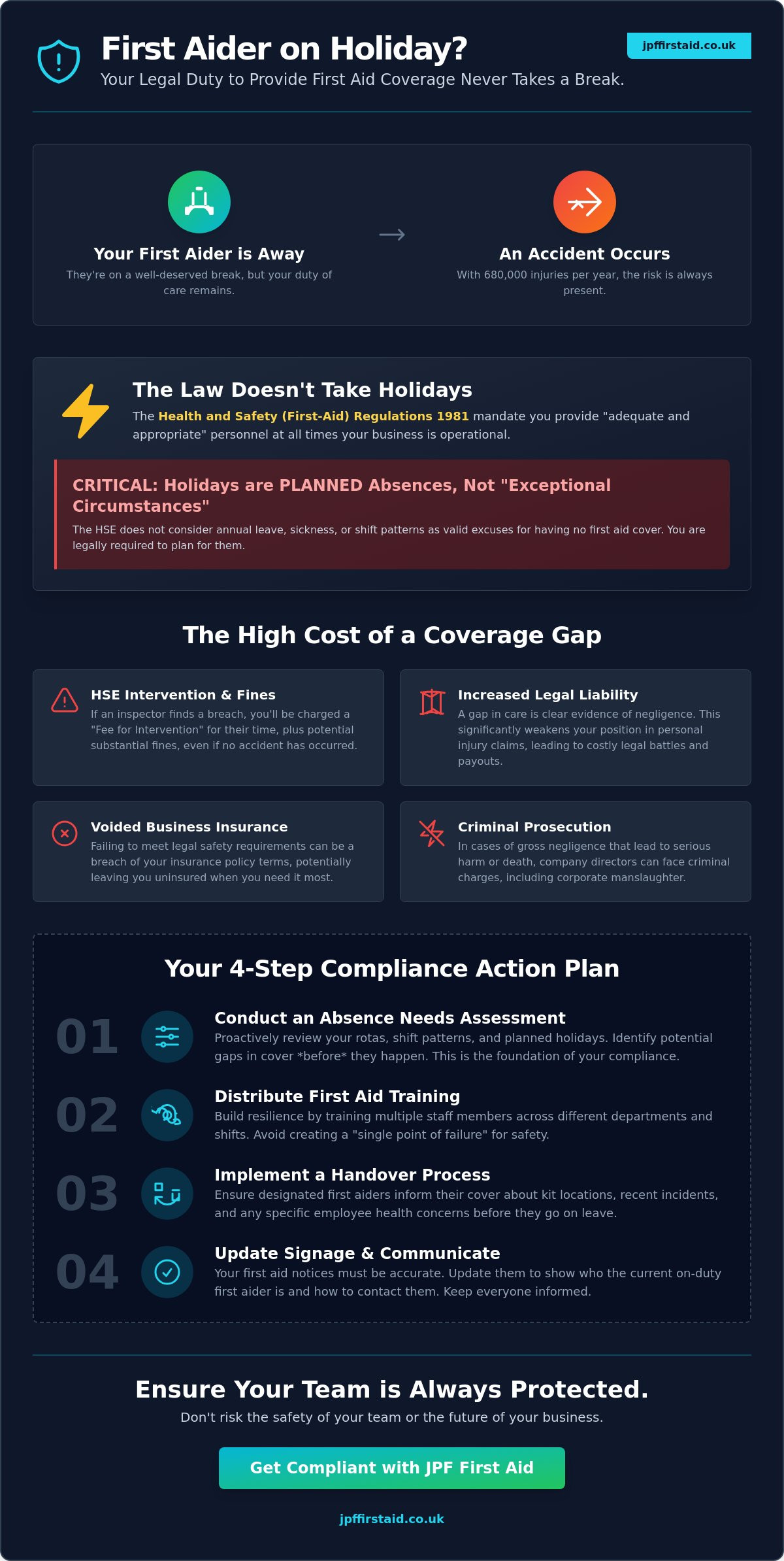
Under the Health and Safety (First-Aid) Regulations 1981, your responsibility as an employer is crystal clear. You must provide adequate and appropriate equipment, facilities, and personnel to ensure your employees receive immediate attention if they are injured or taken ill at work. This duty doesn’t pause when your staff take leave. Many business owners wonder what happens if a designated first aider is on holiday, often assuming a temporary gap in cover is acceptable. However, the law doesn’t view annual leave as an “exceptional circumstance.” Whether it’s a planned two-week summer break or an unexpected bout of flu, your legal obligation to provide cover remains constant every single minute your business is operational.
Failing to meet these standards carries heavy risks for your organisation. In the 2024/2025 period, 124 workers were killed in work-related accidents across Great Britain. While these are extreme cases, the Health and Safety Executive (HSE) can issue material breach notices or substantial fines even if an accident hasn’t happened yet. If an injury does occur while your first aider is away and you haven’t arranged cover, the consequences can be severe:
- HSE interventions and costly “Fee for Intervention” charges.
- Increased liability during personal injury claims.
- The potential for business insurance policies to be voided due to non-compliance.
- Criminal prosecution in cases of gross negligence.
If you are unsure what happens if a designated first aider is on holiday regarding your specific site, the answer is that your “adequate” provision must be maintained at all times. This isn’t just about ticking a box; it’s about ensuring life-saving support is always within reach.
The Definition of “Adequate and Appropriate” Provision
Adequacy isn’t a one-size-fits-all number. It’s determined by your First Aid Needs Assessment, which looks at the specific hazards of your workplace. If you run a high-risk manufacturing site or have staff working late-night shifts, you need more robust cover than a small, low-risk office. Providing effective first aid means having someone on-site who can actually step in, not just someone who holds a certificate but is currently 200 miles away on a beach. Your assessment must account for shift patterns, overtime, and all planned absences to remain compliant.
Duty of Care: Beyond the Legal Minimum
Compliance is about more than just avoiding fines; it’s about the culture you build. When you prioritise continuous safety cover, you show your team that their wellbeing is a genuine priority. This builds trust and improves morale, which is vital for staff retention in any modern business. A “Safety Vacuum” occurs when the only person trained to save a life is absent, leaving your remaining team members feeling vulnerable and your business legally unprotected. By planning ahead, you replace that anxiety with the confidence that your team is always in safe hands.
The Risks of Inadequate First Aid Provision During Staff Absences
Leaving your workplace without a trained responder is a gamble that rarely pays off. When considering what happens if a designated first aider is on holiday, the most immediate danger is the loss of precious seconds during a medical crisis. In 2022/2023, slips, trips, and falls accounted for 32% of non-fatal injuries. Without a designated leader to manage the scene, panic often takes over. This delay in treatment can turn a manageable injury into a life-changing event. Beyond the physical risk, you face the very real threat of an HSE “Fee for Intervention.” If an inspector visits and finds your first aid provision is lacking, you’ll be billed for their time to rectify the breach. This doesn’t just hurt the wallet; it damages your reputation as a responsible employer.
It’s a common question for small business owners: what happens if a designated first aider is on holiday and an accident occurs? The answer usually involves a messy mix of legal and financial stress that can be easily avoided with better planning.
Legal Liability and the “Gap in Care”
Legal liability becomes a massive headache when there’s a clear gap in care. Personal injury solicitors often look for evidence of negligence; a missing first aider is a prime target. If an incident is reportable under RIDDOR, the HSE will investigate your staffing levels at the time. Consider a hypothetical office where the only first aider is away for two weeks. A staff member suffers a severe allergic reaction, but nobody knows where the adrenaline auto-injector is kept or how to use it. That lack of preparation is exactly what HSE guidelines on first aid cover aim to prevent. You might even find your business insurance provider refuses to pay out, arguing that you failed to maintain the safety standards agreed upon in your policy.
The Impact on Workplace Productivity and Confidence
There’s also a psychological price to pay. Employees notice when their safety net is removed. If your team knows the safety person is away, anxiety levels can rise, subtly impacting productivity. This environment often triggers the “bystander effect.” People hesitate to help because they assume someone else will take charge. Without a trained leader, the group can become paralysed by indecision. Investing in emergency first aid at work for multiple team members ensures that confidence remains high, regardless of who is in the office. It creates a culture where everyone feels protected. If you’re worried about your current coverage levels, our team can help you audit your needs to ensure you’re never left vulnerable.
How to Plan for First Aider Holidays, Sickness, and Shift Patterns
Planning for absences shouldn’t be a source of stress. It’s about building a system that works even when your key people aren’t there. When thinking about what happens if a designated first aider is on holiday, the best approach is to treat it like any other critical business operation. You wouldn’t leave your payroll or IT department completely unstaffed; first aid deserves the same level of foresight. Start by conducting a specific “Absence Needs Assessment.” This involves looking at your holiday calendar for the year and identifying weeks where multiple staff are likely to be off. If your primary first aider and their backup both book the same week in August, you have a compliance red zone that needs addressing before the flights are even booked.
A simple but effective tool is the “First Aid Handover.” Before a designated person goes on leave, they should walk their deputy through the location of the first aid kit, the AED, and any specific employee medical records. It’s about passing on confidence as much as information. Training “Deputy First Aiders” is the gold standard for workplace resilience. By having a primary and a backup for every shift, you ensure that one person’s absence never leaves the building vulnerable. It turns a potential crisis into a non-event and keeps your operations running smoothly.
The Role of the Appointed Person vs. a Trained First Aider
While a trained first aider holds a regulated qualification, an “Appointed Person” is someone who takes charge of the first aid arrangements. They aren’t necessarily required to administer clinical care. Under the Health and Safety (First-Aid) Regulations 1981, an appointed person can be a temporary solution in very low-risk environments during short, unplanned gaps. They must know how to call the emergency services and where the kit is kept. However, for higher-risk sites or long-term leave, an appointed person is rarely enough to meet the legal definition of “adequate” cover during a week-long holiday.
Creating a Robust First Aid Rota
Managing a rota involves more than just counting heads. You should aim for a ratio that keeps you compliant based on your specific risks. For example, a low-risk office might require one first aider per 50 people, while a high-risk site might need one per 25. Use your HR software or digital calendars to flag these requirements. If a holiday request drops your coverage below your assessed minimum, you have two choices: decline the leave or train another team member. Most businesses find that certifying a third or fourth person is far easier than trying to manage a restrictive holiday policy. It gives you flexibility and ensures your team feels safe all year round.
Best Practices for Maintaining Workplace Safety Resilience
Building resilience is about ensuring that what happens if a designated first aider is on holiday never becomes a crisis. It moves your strategy from basic compliance to genuine protection. A common mistake is training a single group of people who all sit in the same office. If a medical emergency occurs on the warehouse floor while your only first aider is in a third-floor board meeting, that training is effectively useless. Distributing first aid courses across different departments and floors ensures help is always seconds away. You should also hold short, informal refresher drills. These micro-sessions keep backup staff confident and familiar with the kit, ensuring their skills don’t go rusty between the three-year certification cycles.
Resilience also means looking at the physical location of your responders. If your designated person is often in meetings or travels between sites, you have a hidden gap in your cover. Identifying “floor backups” who are rarely away from their primary workstation provides a consistent safety net. This approach ensures that what happens if a designated first aider is on holiday is simply a smooth transition to an equally capable colleague who is already on-site and ready to act.
Diversifying Your First Aid Team
Avoid the trap of only training your management team. Managers are often the most mobile staff, frequently tied up in off-site meetings or long calls. Instead, look for “anchor” employees. These are the people who are usually at their desks or on the shop floor throughout the day. Training part-time or hybrid staff is also a smart move for modern offices. It ensures you have a rotating cast of responders available regardless of who is working from home. To create a truly holistic safety net, many businesses now find that mental health first aid training is the perfect partner for physical skills. It gives your team the tools to support colleagues through emotional distress, which is now an explicit part of HSE needs assessments as of early 2024.
Communication and Signage During Absences
Your first aid posters shouldn’t be static documents that gather dust. Use “Your First Aider is…” signs with magnetic nameplates or dry-wipe sections. This makes it easy to update the “on-call” person when someone is away. For larger teams, digital communication is your best friend. A quick morning announcement on Slack or Microsoft Teams can identify the safety lead for the day. This simple habit removes the guesswork during a high-stress event. You must also ensure that the “Appointed Person” or the backup responder has immediate access to keys for first aid rooms or locked medical cabinets. If you want to ensure your team is fully prepared for any absence, you can book a bespoke on-site training session to certify your backups all at once.
Securing Your Workplace Compliance with JPF First Aid
At JPF First Aid, we believe that compliance should be a source of confidence, not a logistical headache. When you worry about what happens if a designated first aider is on holiday, the answer shouldn’t be a frantic scramble for cover. We specialise in delivering bespoke, on-site training that fits around your schedule. Our “Reliable Expert Mentor” approach ensures that your team doesn’t just pass a test; they gain the genuine skills needed to act in a crisis. By bringing the training to you, we remove the hassle of travel and keep your staff in their familiar environment. This makes the learning experience practical and relevant to your specific site hazards.
Training multiple staff members at once is the most cost-effective way to build a safety net. For groups of up to 12 people, on-site training can start from £395 or £700 + VAT depending on the specific qualification required. This flat-rate approach makes it simple to justify the cost of certifying backups. You’ll move from having a single point of failure to having a resilient team that can handle any absence, whether it’s a planned holiday or a last-minute sickness.
Why a “First Aid Squad” is Better Than a Sole Responder
Relying on one person creates immense pressure on that individual. By creating a “First Aid Squad,” you distribute that weight across the team. This doesn’t just help with holiday cover; it turns first aid into a shared culture of care. Group sessions often act as a powerful team-building exercise, as colleagues learn to trust each other in simulated emergency scenarios. We make sure our training sessions are always engaging and fun, which significantly reduces learner anxiety and helps the information stick. When your team enjoys the process, they’re far more likely to feel confident when what happens if a designated first aider is on holiday actually occurs.
Next Steps: Booking Your Compliance Review and Training
Getting your workplace up to standard is a straightforward process. We offer flexible, blended learning options that combine online theory with practical on-site assessments. This is perfect for busy schedules, as it reduces the time staff spend away from their primary roles. Whether you need a 1-day Emergency First Aid at Work course or a full 3-day First Aid at Work qualification, we provide a clear path to action. Our goal is to leave you with total peace of mind that your business is legally compliant and your staff are in safe, expert hands.
Ensure your workplace is never without a first aider; book your group training today.
Build a Resilient Safety Plan for Your Team
Maintaining legal compliance is about more than just avoiding HSE fines; it’s about protecting the people who make your business successful. You’ve seen that the Health and Safety (First-Aid) Regulations 1981 require continuous cover and that holidays must be planned for well in advance. Understanding exactly what happens if a designated first aider is on holiday allows you to move from a reactive approach to a proactive, resilient strategy. By training a “First Aid Squad” rather than relying on one individual, you ensure that your site is never left without a qualified responder.
As a multi-award-winning training provider with over 20 years of industry experience, JPF First Aid is here to help you navigate these requirements with ease. Our Ofqual regulated qualifications are designed to be engaging and practical, giving your team the skills and confidence they need to act when it matters most. You don’t have to manage these regulations alone. Secure your workplace compliance with our expert first aid training and view our courses here. We look forward to helping you create a safer, more confident workplace for everyone.
Frequently Asked Questions
Is it a legal requirement to have a first aider on site at all times?
Yes, you must provide adequate first aid cover whenever people are at work. This is a core requirement of the Health and Safety (First-Aid) Regulations 1981. Whether your team is working late shifts, weekends, or bank holidays, your legal duty to provide immediate assistance doesn’t change. If your business is open, you need a plan in place to manage medical emergencies effectively.
What is the difference between a first aider and an appointed person?
A first aider is someone who has completed a regulated qualification, such as a 1-day or 3-day course. An “appointed person” is a minimum requirement for low-risk environments. Their role is to look after the first aid equipment and call the emergency services. They aren’t trained to give clinical treatment, so they shouldn’t be your only cover in higher-risk workplaces.
How many first aiders do I need for my small business?
The exact number depends on your specific First Aid Needs Assessment. Generally, a low-risk office needs at least one trained person for every 50 employees. In higher-risk settings, like construction or manufacturing, you’ll need one for every 25. You must always train extra staff to ensure you aren’t left vulnerable when considering what happens if a designated first aider is on holiday.
Can a manager double as a first aider, or should it be a dedicated role?
A manager can certainly be a first aider, but they must be available to respond instantly. If your managers are often tied up in long meetings or frequently work off-site, they shouldn’t be your primary source of cover. It’s often better to train staff who are “anchored” to the shop floor or office, ensuring they can reach a casualty within seconds.
What happens if our only first aider is off sick unexpectedly?
Unexpected sickness is treated as a temporary circumstance, but you’re still responsible for employee safety. While the HSE is more lenient with unplanned illness than with holidays, you should still have a backup responder. This is exactly why we recommend a “First Aid Squad” approach. It removes the stress of what happens if a designated first aider is on holiday or off sick at short notice.
Do I need to pay my staff extra for being a designated first aider?
There’s no legal requirement to provide extra pay for first aid duties in the UK. However, many employers choose to offer a small monthly allowance or an annual bonus as a gesture of goodwill. This recognises the extra responsibility the employee has taken on and helps to encourage volunteers when you’re looking to expand your team of responders.
How often does a first aid certificate need to be renewed in the UK?
Regulated certificates, such as FAW and EFAW, are valid for three years from the date of issue. Once they expire, the staff member is no longer considered a qualified first aider. The HSE also strongly recommends that all first aiders attend a 3-hour annual refresher course. This keeps their life-saving skills sharp and their confidence high between full re-qualifications.
Can I use a first aider from a neighbouring business in an emergency?
You can share first aid local provision, but only if you have a formal, written agreement with the other business. This agreement must ensure that the first aider is always available and can reach your site quickly. You can’t simply rely on a “handshake deal” or assume they’ll be in the office when you need them; it must be documented in your needs assessment.
Recent Comments